
Beads / GUIDE
Easy Perler Bead Patterns With Printable Grids
Choose from eight original fruit, leaf, shape and animal designs. Each comes with a printable grid, a color key and an exact bead count.
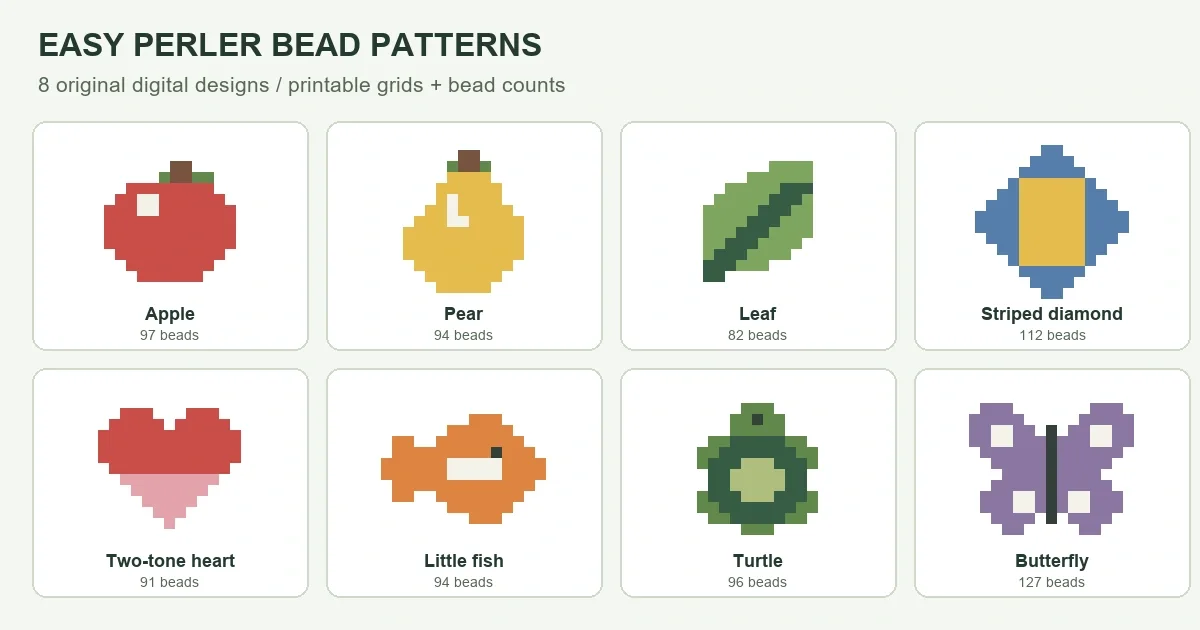
These easy Perler bead patterns for beginners give you eight original designs to copy from a numbered grid: two fruits, a leaf, two shapes and three animals. Start with the two-tone heart for a simple color change, or choose the leaf for the lowest bead count.
Each pattern includes a free printable PDF with a lettered color key and bead totals. These are digital charts, not photos of finished pieces; the counts and edge connections have been checked in the chart data, but the designs have not been physically fused or print-alignment tested.
Easy Perler Bead Patterns to Try
Looking for cute Perler bead patterns without a long supply list? These Perler bead ideas use two to four colors each. Color names below describe the chart palette, not specific product codes. Choose suitable shades from your own beads; screen and bead colors can differ.
How to read the grids: one lettered square means one bead. A blank square means no bead, even when the design uses white. White beads are marked W. Read rows from top to bottom and columns from left to right; the number at the right of each row is its bead total.
1. Apple
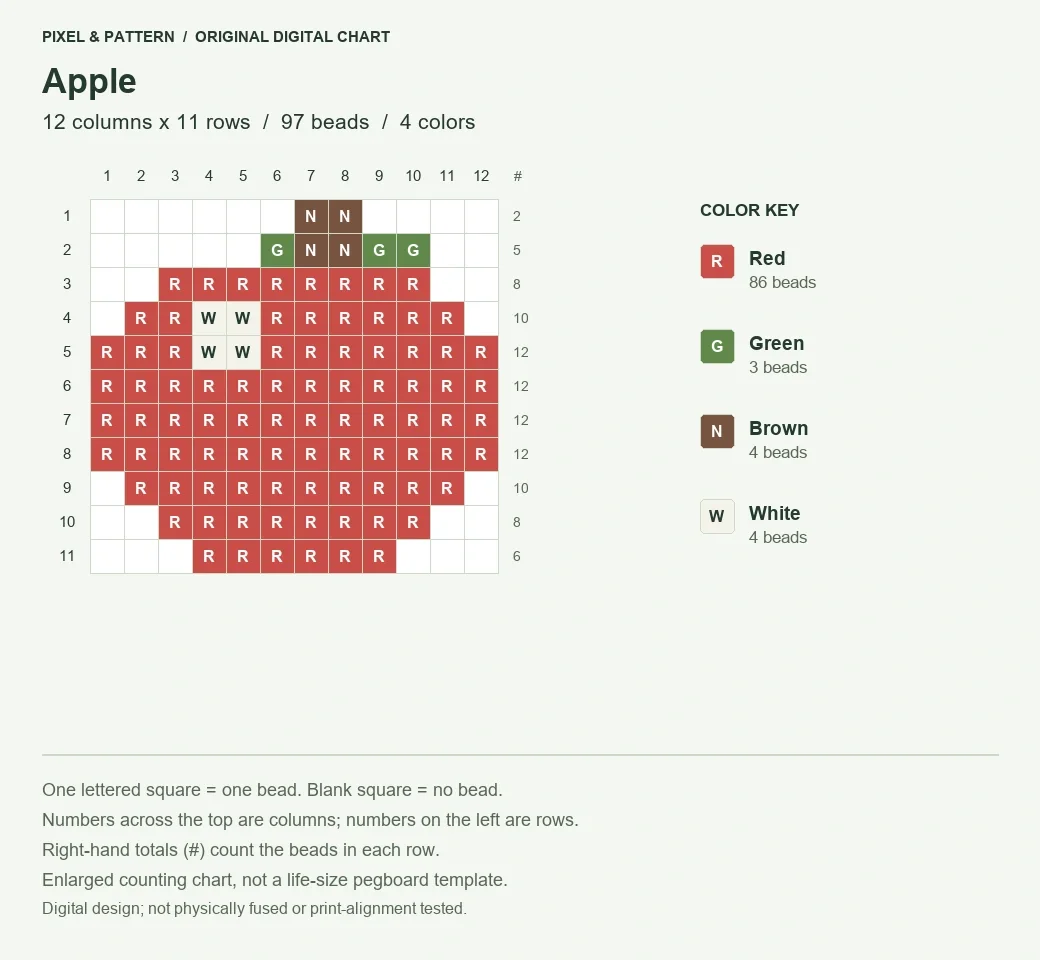
12 columns × 11 rows · 97 beads · 4 colors.
Red (R): 86; Green (G): 3; Brown (N): 4; White (W): 4.
The four white beads create a highlight inside a mostly red shape. Keep the green leaf cells and brown stem separate when counting the top two rows; they are part of the 97-bead total.
Download the apple pattern sheet (PDF)
2. Pear
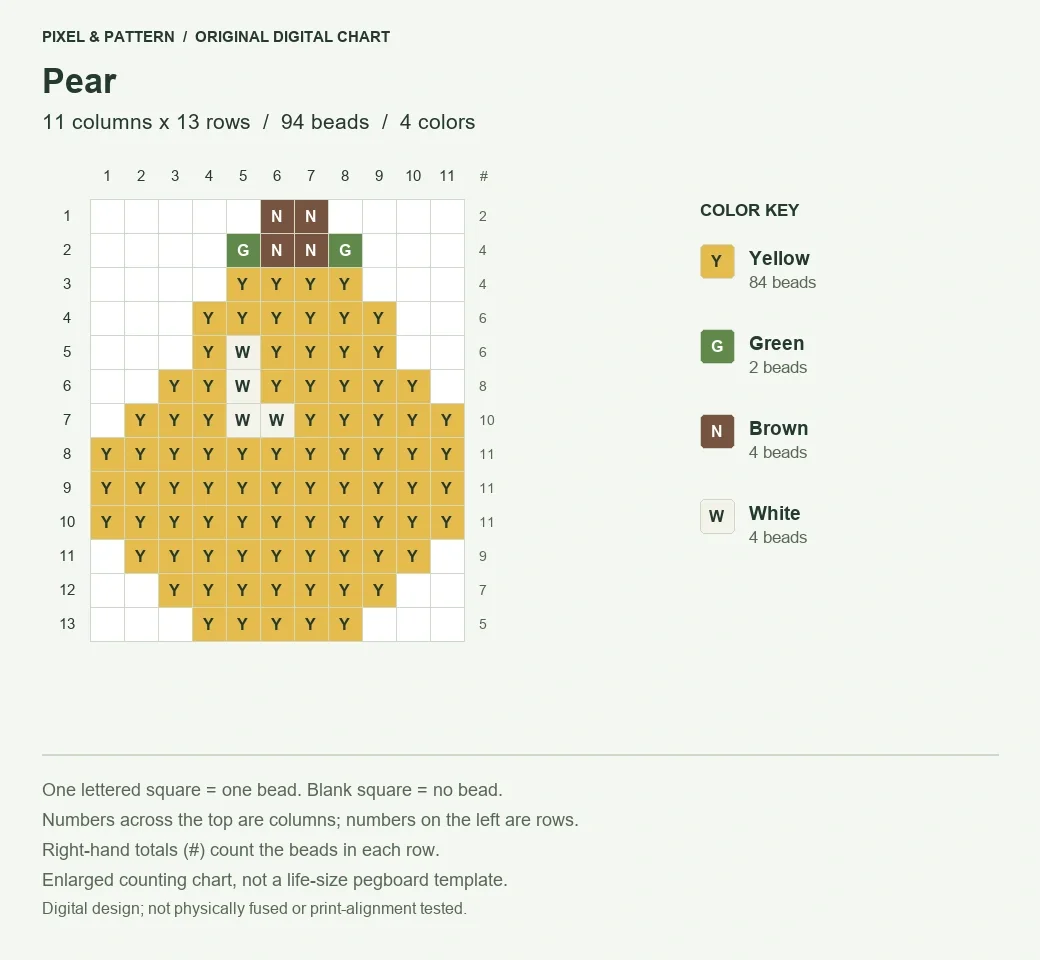
11 columns × 13 rows · 94 beads · 4 colors.
Yellow (Y): 84; Green (G): 2; Brown (N): 4; White (W): 4.
This pear uses the same four color groups as the apple, with yellow replacing red. Its narrower neck widens into a rounded base. Follow the blank cells at the edges instead of filling the whole rectangle.
Download the pear pattern sheet (PDF)
3. Leaf
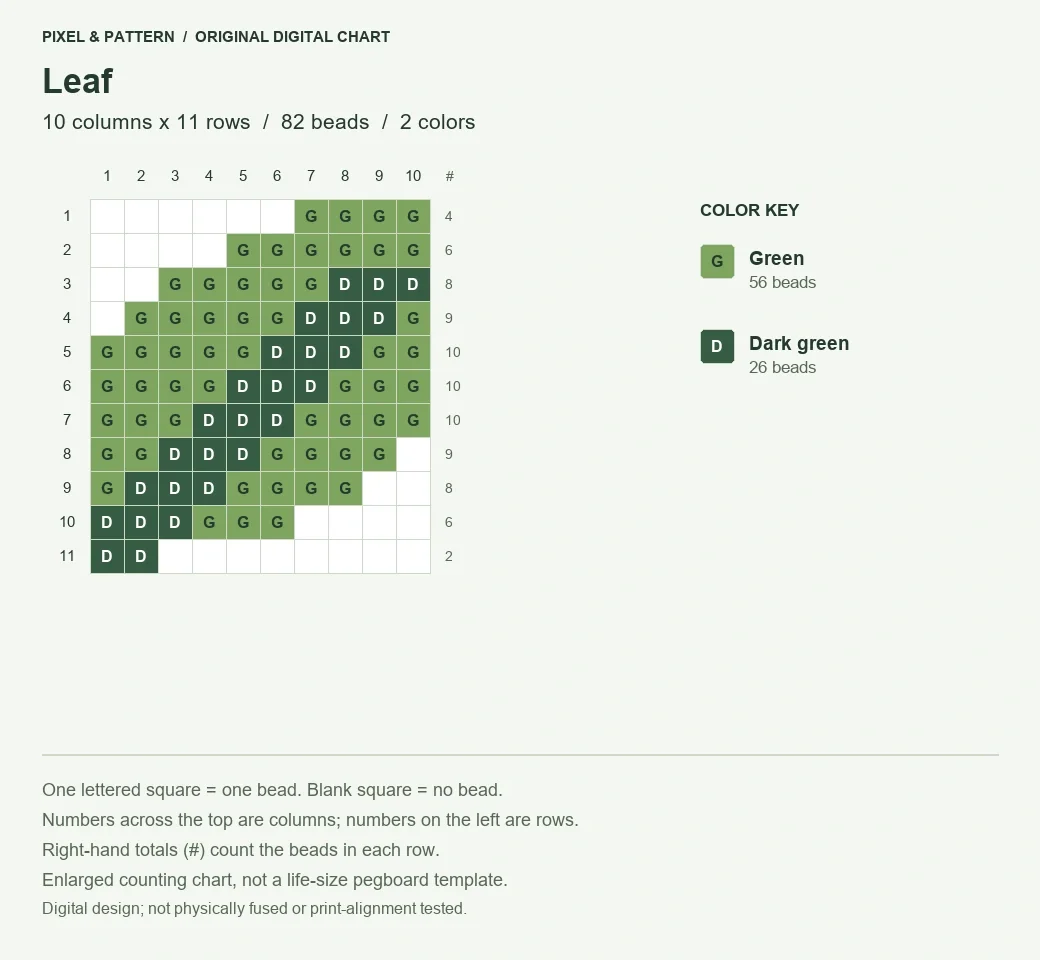
10 columns × 11 rows · 82 beads · 2 colors.
Green (G): 56; Dark green (D): 26.
With two colors and 82 beads, the leaf has the lowest bead count in this set. Follow the dark-green vein diagonally through the shape, counting the full row each time so the vein does not drift.
Download the leaf pattern sheet (PDF)
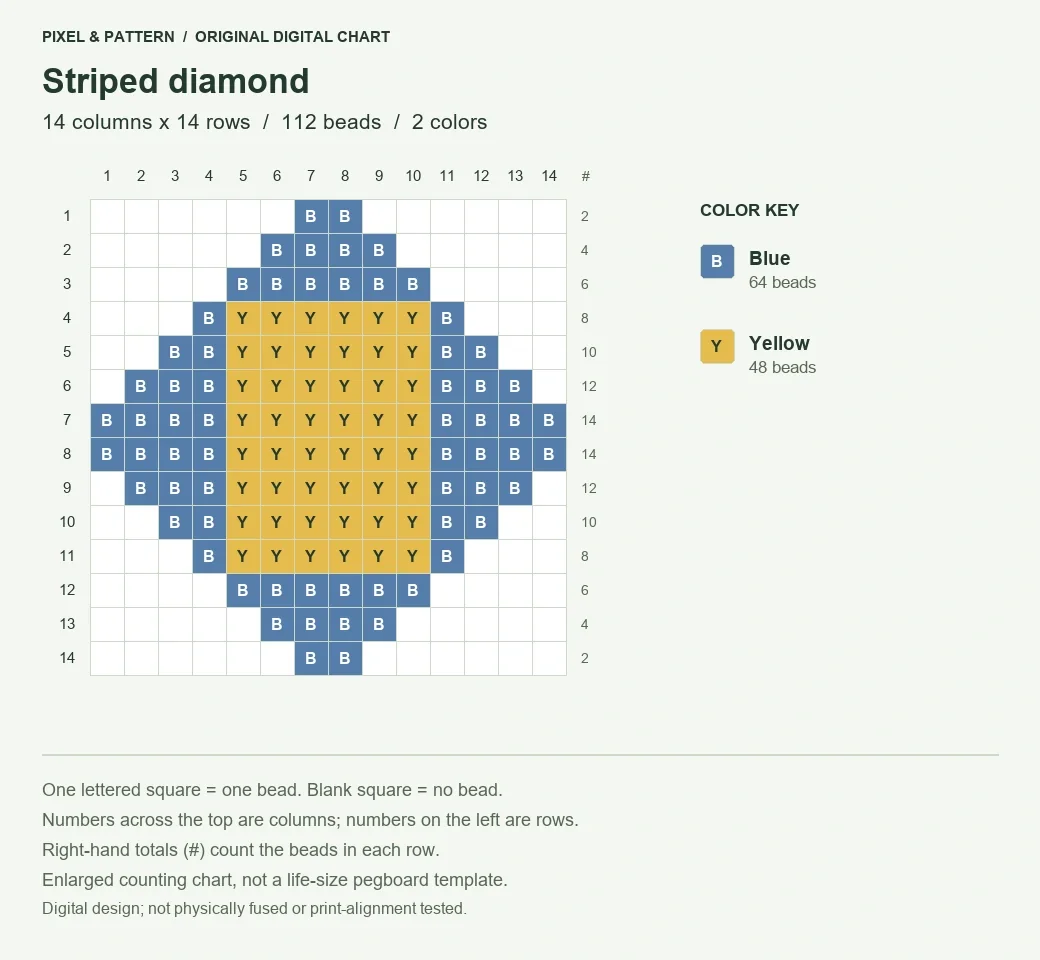
4. Striped diamond
14 columns × 14 rows · 112 beads · 2 colors.
Blue (B): 64; Yellow (Y): 48.
The blue outline and yellow center form a mirrored geometric design. The widest two rows each use 14 beads. After those rows, the outline narrows in the reverse order, giving you an easy way to check your placement.
Download the striped diamond pattern sheet (PDF)
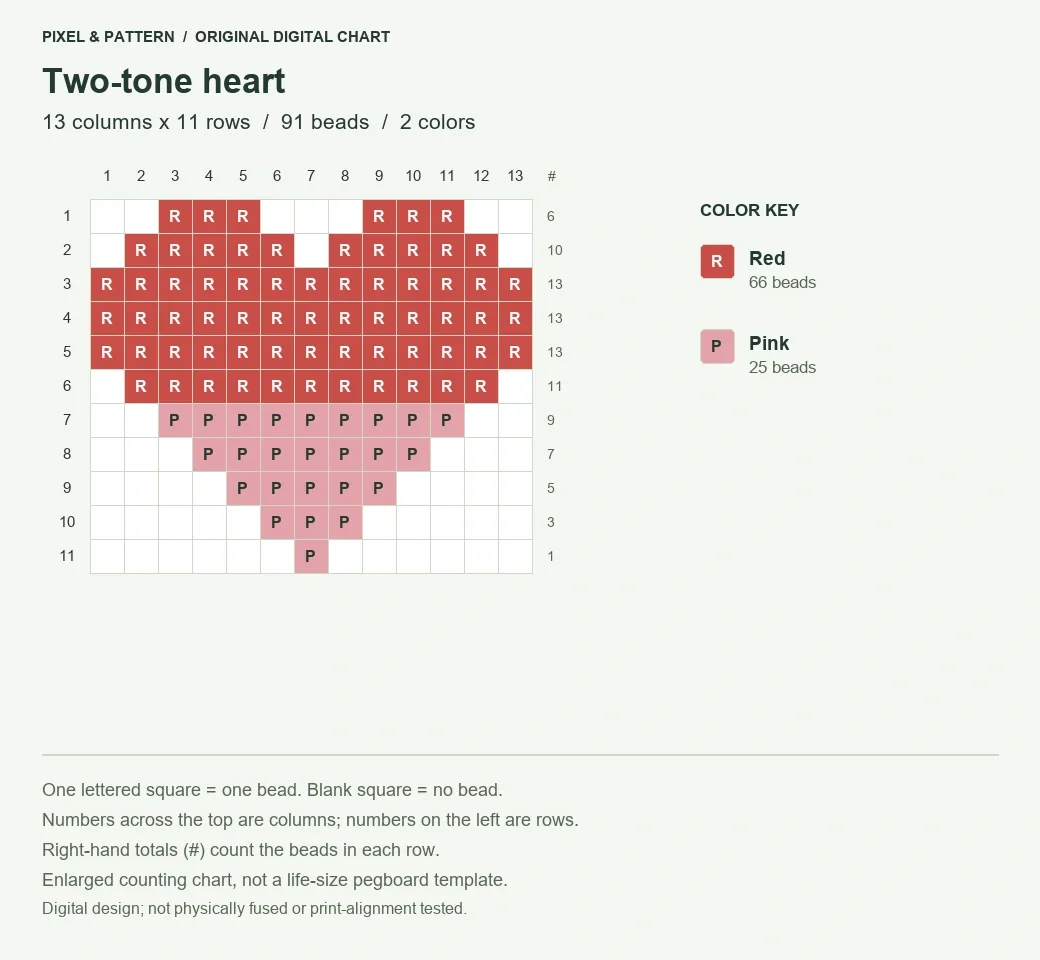
5. Two-tone heart
13 columns × 11 rows · 91 beads · 2 colors.
Red (R): 66; Pink (P): 25.
This is a useful first choice if you want just one main color change: red at the top, pink from row 7 onward. The blank notch between the two lobes is intentional; leave those pegs empty.
Download the two-tone heart pattern sheet (PDF)
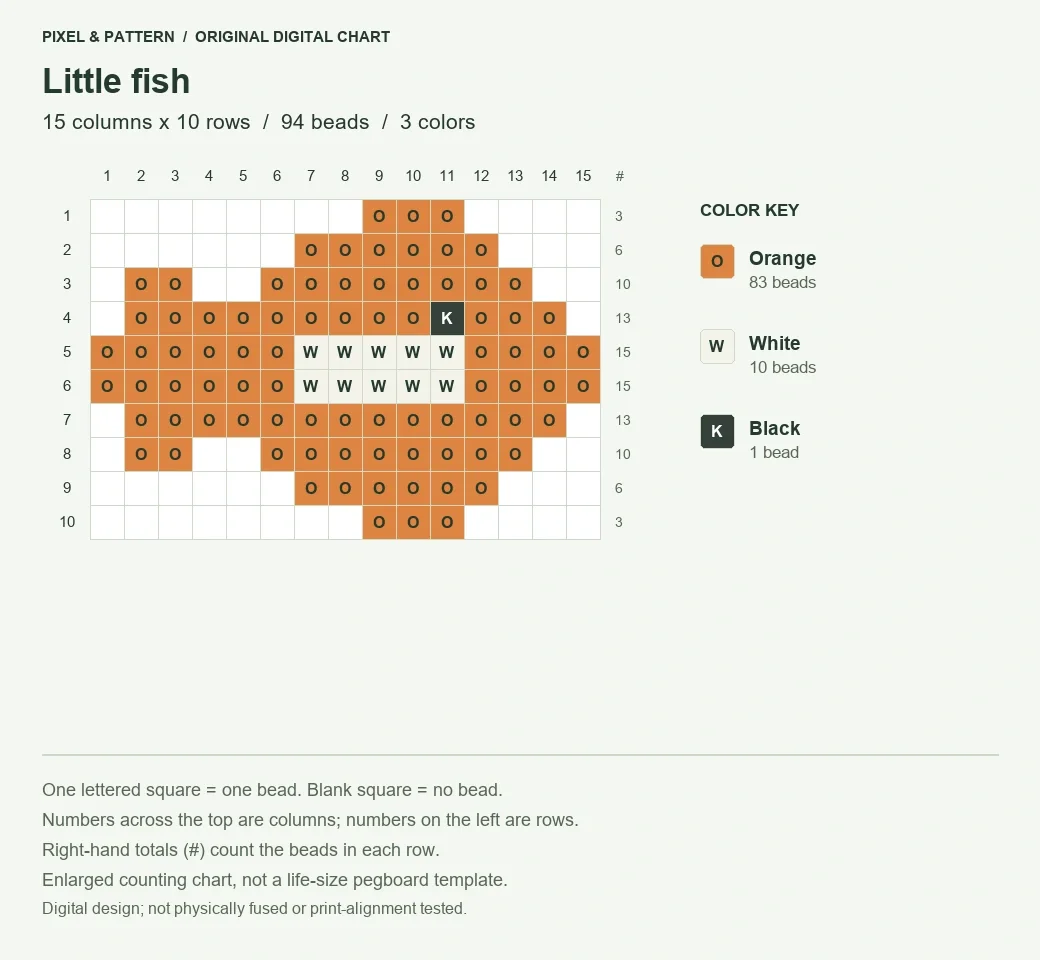
6. Little fish
15 columns × 10 rows · 94 beads · 3 colors.
Orange (O): 83; White (W): 10; Black (K): 1.
The single black eye belongs in row 4, column 11. The white stripe crosses two rows of the orange body. Pay attention to the empty cells between the tail tips and body; filling them changes the silhouette.
Download the little fish pattern sheet (PDF)
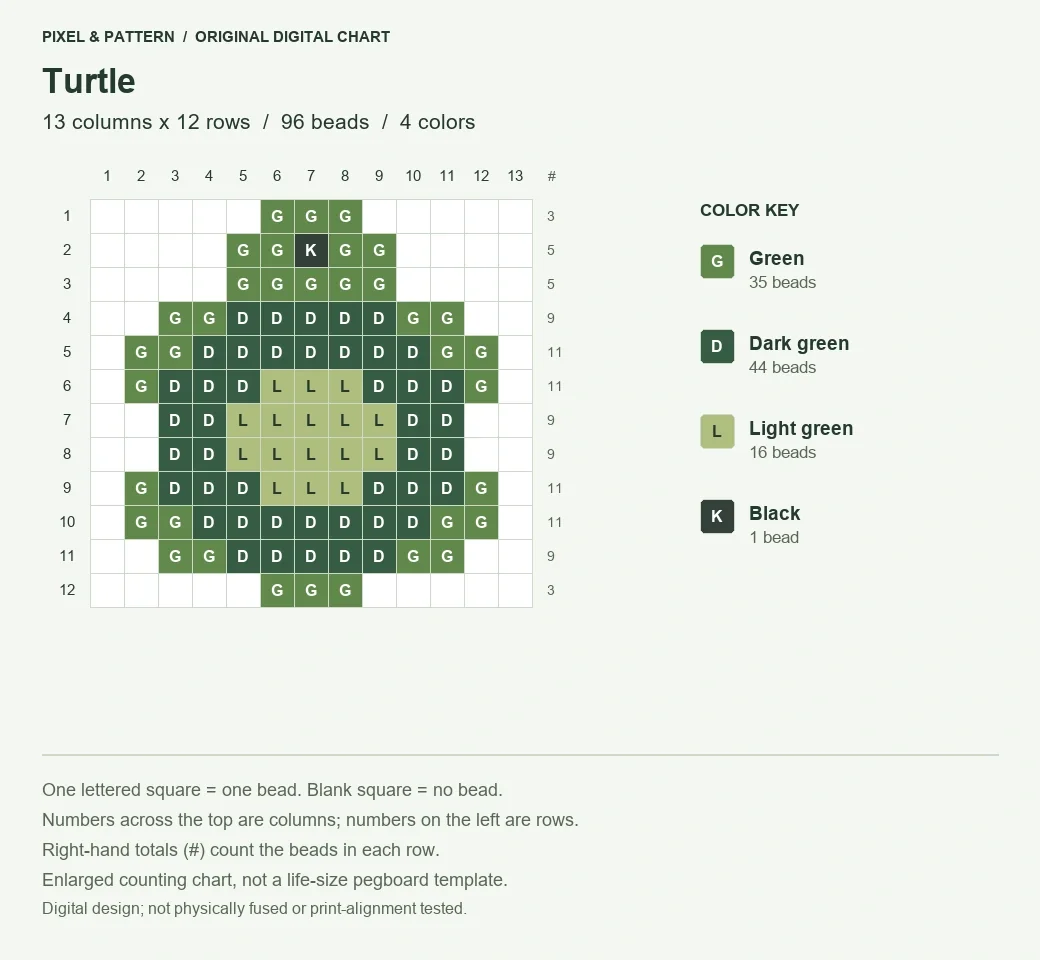
7. Turtle
13 columns × 12 rows · 96 beads · 4 colors.
Green (G): 35; Dark green (D): 44; Light green (L): 16; Black (K): 1.
Build the dark-green shell around its light-green center, then count the green head and feet from the grid. The single black bead is the eye in row 2, column 7. Four colors make this a slightly busier choice than the heart.
Download the turtle pattern sheet (PDF)
8. Butterfly
15 columns × 12 rows · 127 beads · 3 colors.
Purple (P): 102; White (W): 16; Black (K): 9.
The wings mirror one another around the black body. Match the white patches on both sides and preserve the empty gaps around the wing edges. At 127 beads, this is the largest bead count in the collection.
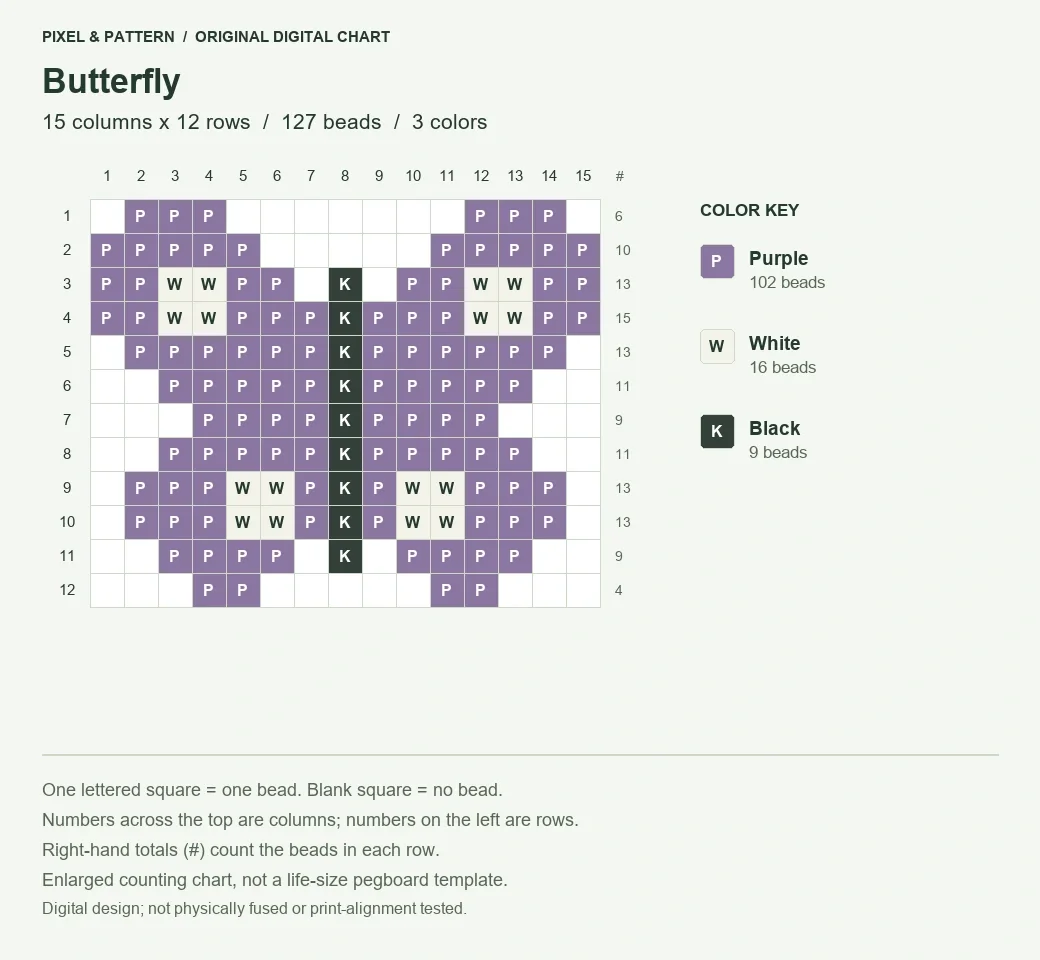
Download the butterfly pattern sheet (PDF)
Choose a Pattern by Grid Size and Bead Count
The dimensions below are columns × rows, including empty cells inside the rectangular chart. They tell you how many peg positions you need across and down, not how many beads to buy. For example, the 14 × 14 diamond covers 196 grid positions but uses only 112 beads.
| Pattern | Grid | Beads | Colors | What to practice |
|---|---|---|---|---|
| Apple | 12 × 11 | 97 | 4 | Stem and highlight placement |
| Pear | 11 × 13 | 94 | 4 | Following a curved outline |
| Leaf | 10 × 11 | 82 | 2 | A diagonal two-color vein |
| Striped diamond | 14 × 14 | 112 | 2 | Matching mirrored rows |
| Two-tone heart | 13 × 11 | 91 | 2 | One main color change |
| Little fish | 15 × 10 | 94 | 3 | Tail gaps and a single eye |
| Turtle | 13 × 12 | 96 | 4 | Counting four color groups |
| Butterfly | 15 × 12 | 127 | 3 | Matching both wings |
For one pattern at a time, a square pegboard with at least 15 columns and 14 rows has enough positions for every design in this collection. Check the peg count on your board and use beads made for its size system. The counts here do not establish a finished size in inches or centimeters.
What makes these Perler bead patterns easy?
Each design uses a short color key and a compact grid. Difficulty is not just the total bead count: the 112-bead diamond repeats a mirrored shape, while the 96-bead turtle asks you to track four colors. Choose by the kind of counting you prefer, not just the smallest total.
Before fusing, compare the bead total in each completed row with the number printed beside it. Check white cells, intentional gaps and any single black eye separately. This catches a missed bead without recounting the entire design.
Download the Printable Pattern Sheets
Download all 8 printable Perler bead patterns (PDF) — one design per page, in the same order as this article. You can also use the individual PDF link beneath each pattern.
- Paper: the file uses US Letter pages. Print one page per sheet; Fit to page also works on A4 for reading and counting.
- Scale: these are enlarged counting charts, not life-size templates to line up under a pegboard. Read the coordinates beside your board instead.
- Color or grayscale: use the letters and color names together. The letter remains the reference if two shades print similarly.
For fusing, follow the instructions supplied with your beads. Perler specifies that an adult should do this step; its standard fusing instructions explain the ironing paper, heat-safe surface and cooling steps. This collection provides placement charts, not a tested ironing recipe.
Want a pattern based on your own image instead of a ready-made motif? Use the Perler bead pattern maker for that separate task.