Crochet / GUIDE
Filet Crochet Half Squares: Reading Partially Filled Charts
A triangle or corner mark needs more context than a blank or solid box. Identify the chart system, check its key and separate motif details from shaped edges.
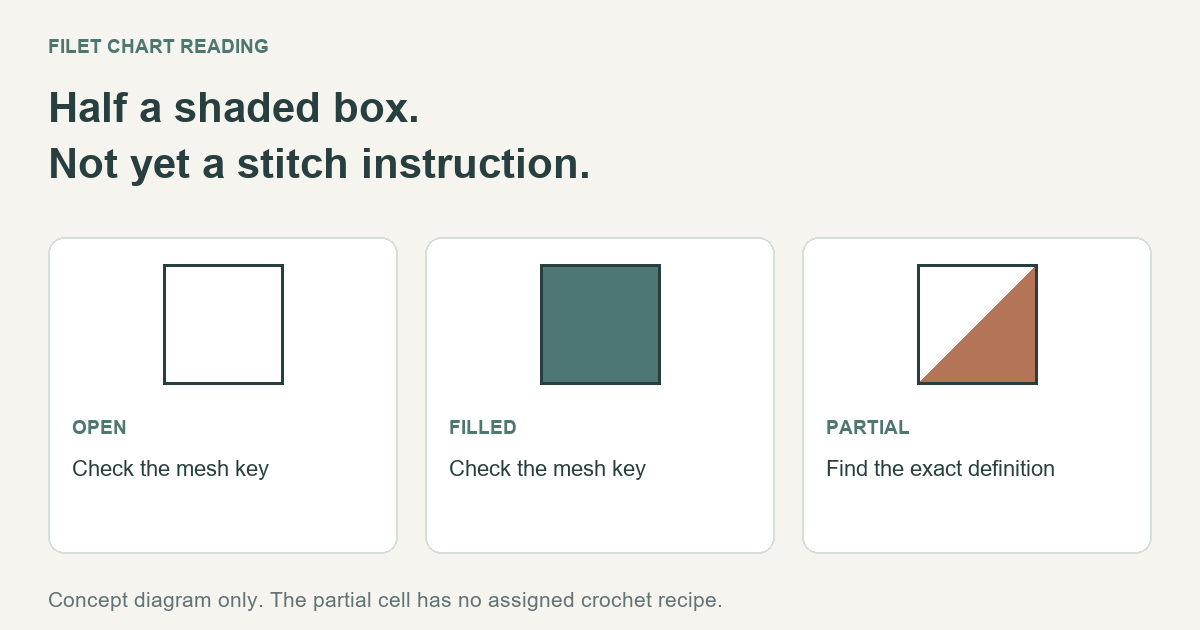
A filet crochet half square cannot be decoded by dividing the stitches of a solid block in two. A shaded triangle, a diagonal stroke and a tiny mark in one corner may belong to different chart systems. The useful question is: what does this particular pattern tell you to work at this particular position?
Start with the original page and its legend. If either is missing, a close-up of the mysterious cell is not enough to establish a stitch sequence. The comparison below helps identify what information to recover before you change the fabric.
Check Which Chart System You Are Reading
Find the designer's title, materials list and symbol key, rather than relying on the caption attached to a saved image. A grid can describe needlework on existing fabric, individual crochet stitches, or groups of stitches forming mesh.
- Cross stitch: look for fabric count, embroidery floss references and a key distinguishing full and fractional stitches. DMC's chart-reading guide describes full, half, quarter and three-quarter stitches. Those instructions are not automatically crochet instructions.
- A filet block chart: look for a definition of the open and solid mesh, including how many chains or stitches span a cell. One box represents a mesh unit rather than necessarily one stitch.
- A crochet stitch diagram: look for individual stitch symbols and their placement. The Craft Yarn Council's symbol reference directs readers back to the pattern key for additional definitions. A familiar-looking dot in an unidentified grid does not establish its meaning.
Useful evidence to collect: the full chart, the exact symbol in its key, the relevant written row and whether the terminology is US or UK. Record the row and column of the problem cell so a designer can identify it without guessing.
Compare Full, Empty and Partially Filled Squares
In a basic filet chart, the open and filled states are only meaningful after the mesh construction has been specified. Hooked on Häkelmaschen's filet introduction distinguishes two common structures, traditionally called 4-dc and 3-dc mesh. Do not carry a stitch count from one into the other.
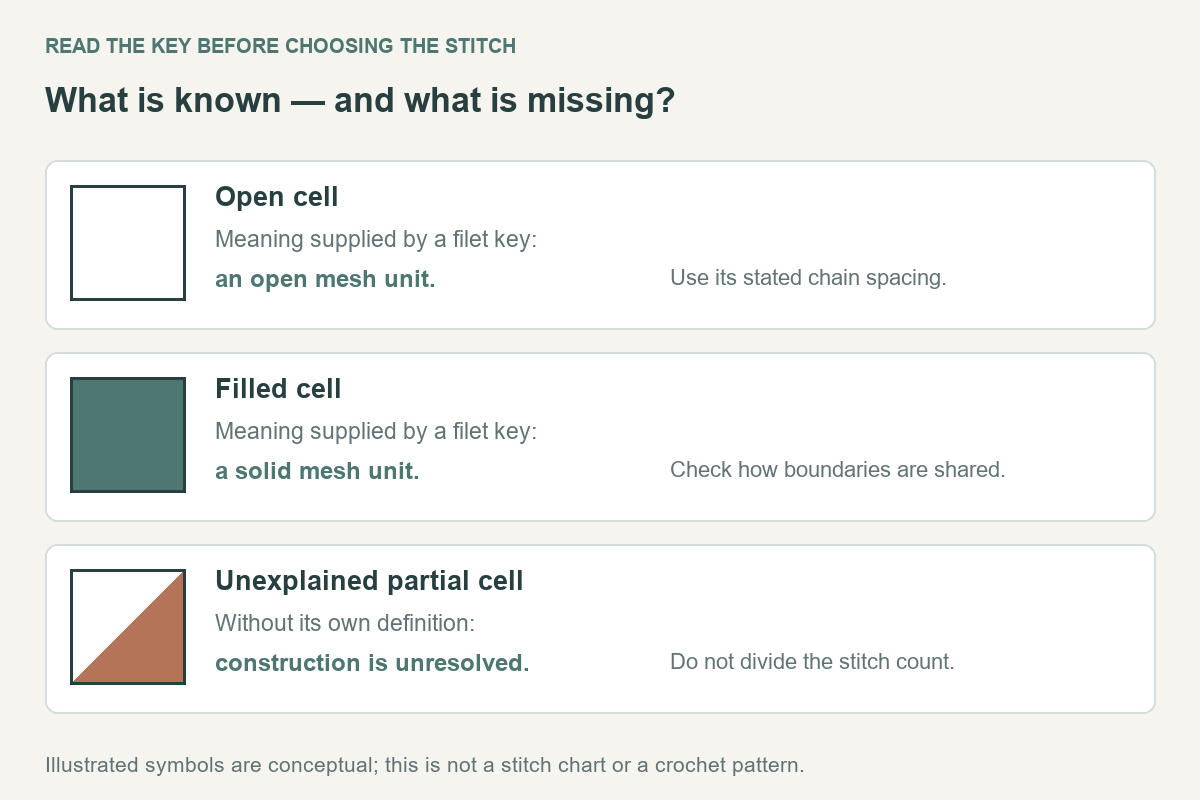
Conceptual chart marks, not a crochet recipe. The partial cell deliberately has no assigned stitch sequence.
| What you see | What must be established | What not to assume |
|---|---|---|
| An empty square | The pattern's open-mesh construction | That the whole space is simply skipped |
| A solid square or X | The defined filled block and shared boundaries | That X means a cross stitch in every grid |
| A triangle, slash or partial fill | A matching special-symbol definition and its location | That half the shading means half the stitches |
Half-filled filet squares inside a motif versus at an edge
An internal partial cell concerns a detail within the design. An edge instruction may instead change the outline of the fabric. A method that narrows a row is not interchangeable with a mark inside a leaf, letter or animal's face.
Check direction as well as shape: an explanation for one diagonal does not establish the opposite diagonal. Likewise, the name half double crochet identifies a stitch, not a universal solution for any square that looks half shaded.
Work Through a Verified Example
A documented slanted edge, with a defined mesh
De Handwerkjuf's large-mesh filet tutorial provides a symbol legend, stitch photographs and videos. It explicitly uses US terminology and a mesh made with three chains and a treble crochet, called “triple” on that page.
For its one-square slanted decrease at the start of a row, the designer specifies five chains after turning, then a treble into the next treble of the previous row. That instruction belongs to a named edge decrease within the author's construction; it is not the usual open-mesh start from that tutorial.
The useful chain of evidence is identified mesh → named location → written action → photographed result. Follow the source for the complete setup and demonstration. The method does not tell you how to work an unexplained triangular cell in the middle of an unrelated chart, and it has not been independently swatched for this article.
When the partial symbol still has no explanation
Send the designer a focused question: “At row [number], column [number], what stitch sequence does this mark represent? Which stitches or spaces does it use, and does the row width change?” Include the key and neighboring cells. This gives them a construction question to answer, rather than asking them to identify an isolated shape.
You can save those details in the partial-cell reading record. It is a reference worksheet, not a tested pattern.
If you choose to redraw the motif using only whole open and solid cells, the full-block filet crochet pattern maker provides that alternative. It does not generate half squares, interpret diagonal symbols or supply shaped-edge instructions. Replacing a partial cell changes the drawing; keep it identified as an adaptation and make a sample before committing to the full piece.