Crochet / GUIDE
How to Read Crochet Charts: Symbols, Grids and Worked Examples
Follow a six-stitch symbol diagram, then decode an asymmetric two-color flag. See why a correct stitch total can still put a motif in the wrong place.
Blue ink on a crochet diagram might separate one row from another; a blue square on a colorwork grid might tell you which yarn to use. Confusing those jobs can change the project before the first stitch is made. Learning how to read crochet charts begins by deciding what each mark controls.
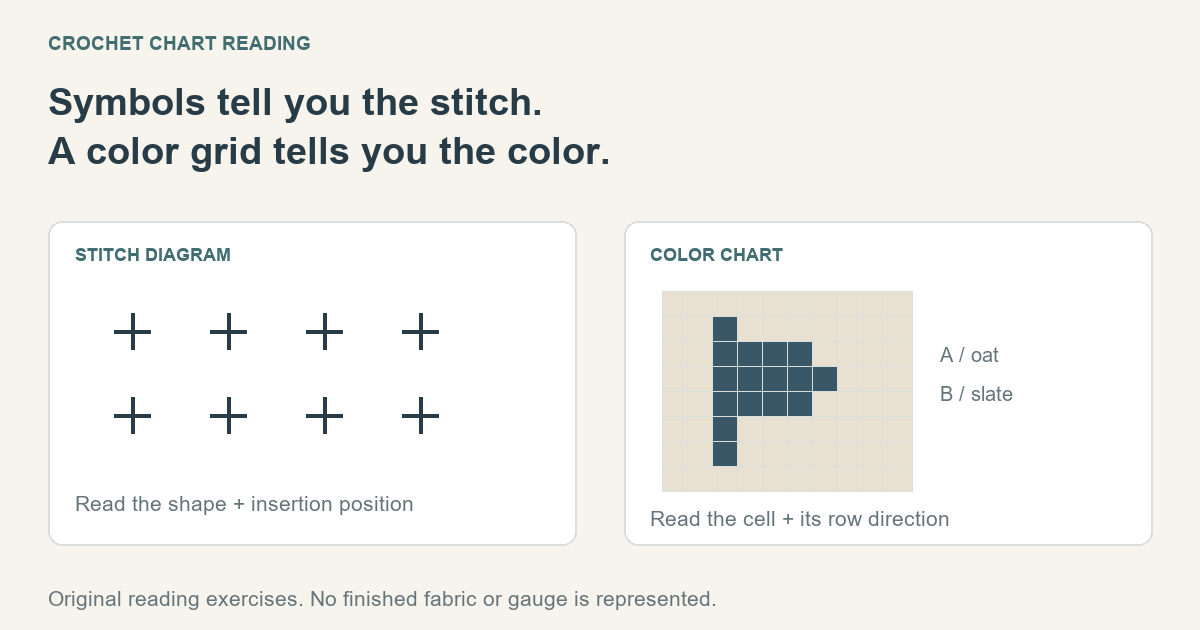
The two original exercises here isolate that difference: a six-stitch diagram specifies stitches, while a small flag grid specifies colors. Their symbols and counts have been checked against the references and chart data. They remain digital exercises; a physical colorwork sample has not yet been made.
Identify Symbols or a Color Grid
| Chart type | What a mark tells you | What to check first |
|---|---|---|
| Stitch-symbol diagram | A stitch and its relationship to nearby stitches | Symbol definitions, insertion points and starting position |
| Tapestry color grid | The color assigned to a position | The stitch represented by a cell and the color key |
A colored square does not identify the crochet technique on its own. A single-crochet grid and a C2C chart can assign different amounts of work to one square. In our flag exercise, the rule is explicit: one cell equals one US single crochet. Background cells also take stitches.
Diagram ink is different from yarn color. Crochet.com's chart guide explains that colors can distinguish rows or highlight repeats. Its lesson also separates charts worked in rows from those worked around a center. Follow the start marker and key; do not treat every diagram as a rectangle read in the same direction.
Read the Legend and Follow the Rows
How to read a crochet diagram with two symbols
Only two stitch symbols appear in this exercise: an oval for chain (ch) and a plus sign for single crochet (sc). These follow the Craft Yarn Council's symbol reference. The arrows describe reading order, not additional stitches.
US terms apply throughout. US single crochet is called double crochet in UK terminology, as shown in the Council's abbreviation comparison. Establish the terminology before translating a symbol into a written abbreviation.
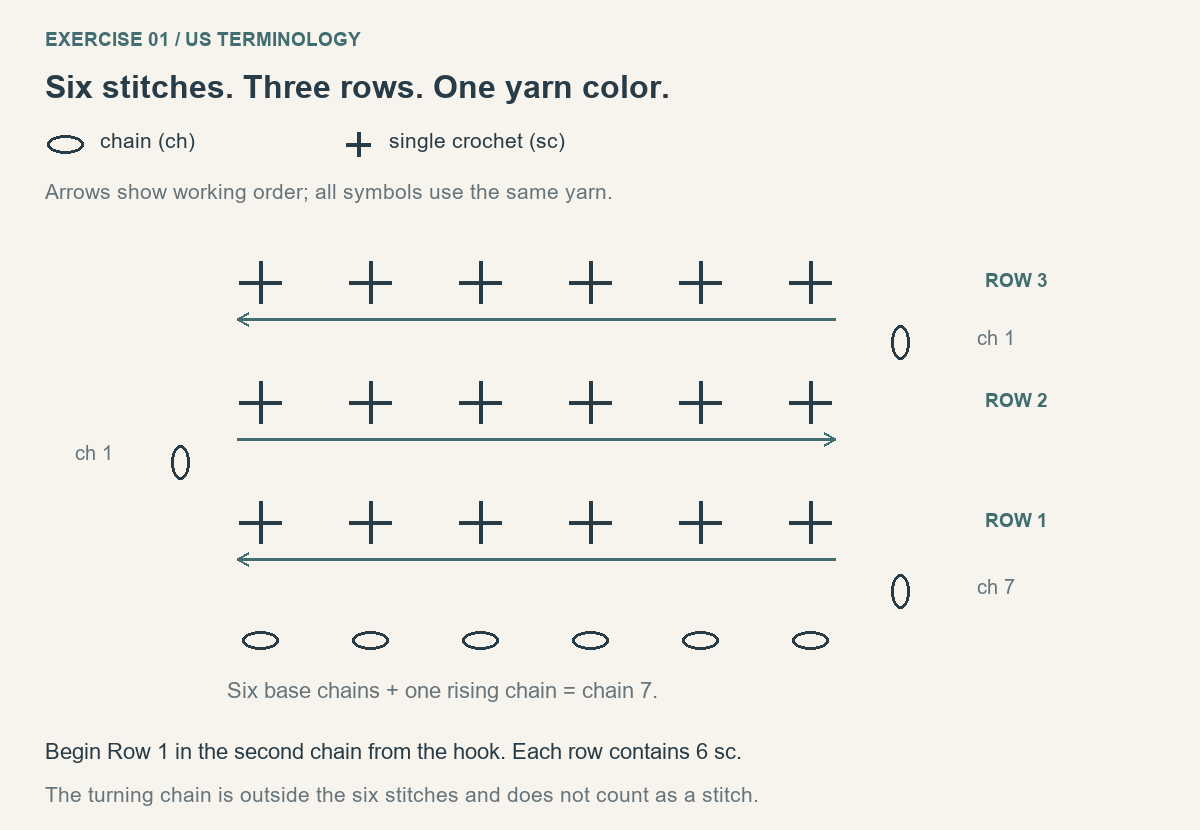
Six single-crochet symbols per row. The foundation contains seven chains; each later turning chain sits outside the six-stitch row.
- Locate the foundation. The six horizontal ovals and the rising oval at the right make seven chains altogether.
- Read row 1 from the right. Begin in the second chain from the hook and work across the remaining chains: six single crochets.
- Follow the turn into row 2. Chain one, turn, then work six single crochets. The diagram's reading arrow now points toward the right.
- Return across row 3. Chain one, turn and work another six single crochets, following the left-pointing arrow.
The setup follows the Council's single-crochet instructions. Learning how to read crochet diagrams is easier when you translate one row, count its resulting stitches, then move upward.
How to read a crochet chart without adding an extra stitch
For this example, the turning chain does not count as a stitch. Row 2 therefore goes into the six existing stitches, not into those six plus the turning chain. If your count grows to seven, compare the row ends with the diagram before continuing. Other patterns can assign turning chains differently; this exercise's rule belongs to this exercise.
Work Through a Small Color-Chart Example
The flag uses A = oat and B = slate on a 10-column, 8-row grid. Its pole sits in column 3, deliberately away from the center so a reversed row is visible. The chart keeps a fixed front view: column 1 stays on the left, and row 1 stays at the bottom.
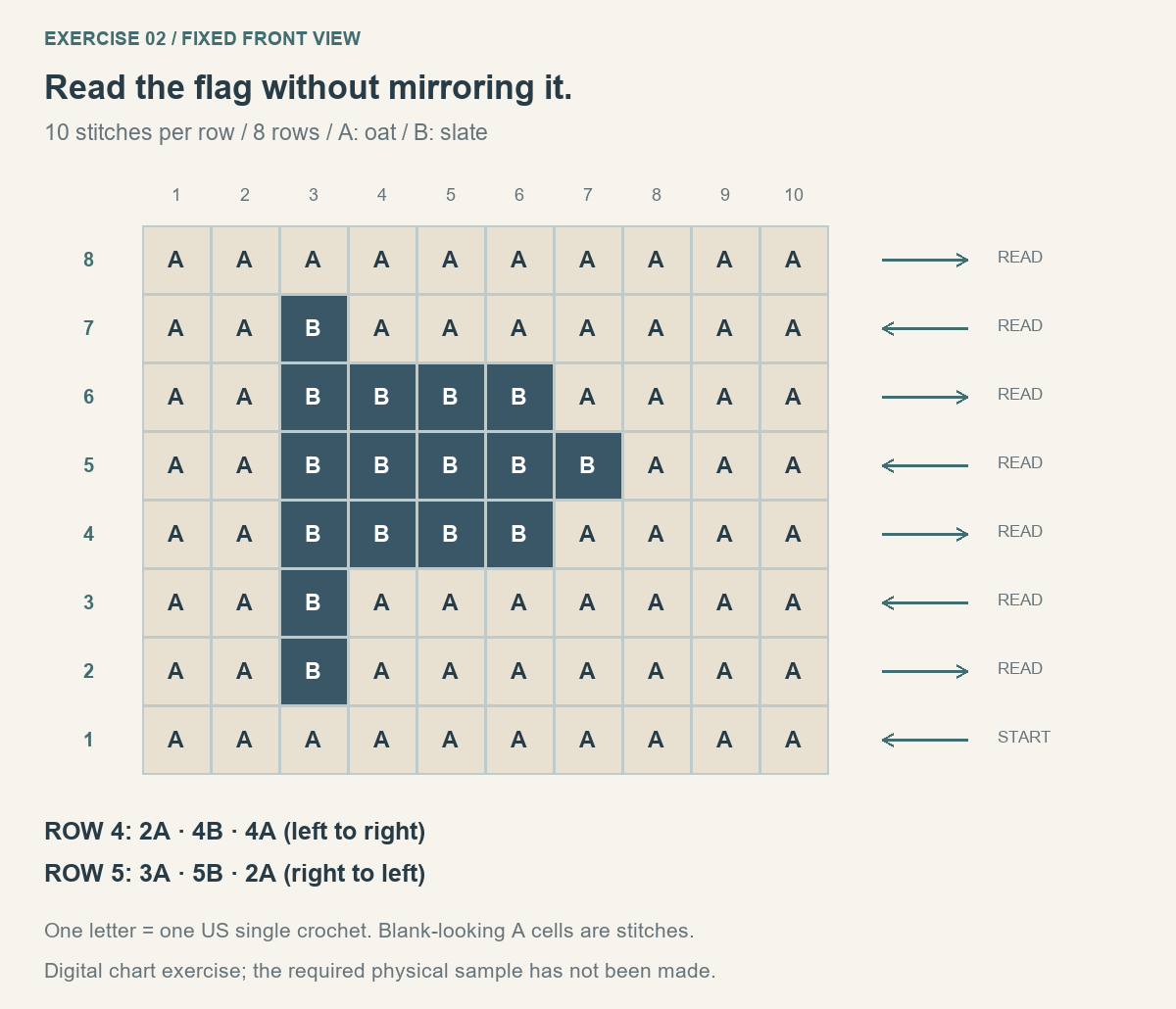
All 80 cells are stitches: 64 in A and 16 in B. These are chart counts, not a yarn estimate or a measured fabric size.
How to read a crochet graph in working order
For this flat, turned-row exercise, begin row 1 at the right. Alternate direction after each turn. The table gives the colors in the order you encounter them, so read each listed sequence from its beginning rather than reversing it again.
| Row | Read the grid | Work these color runs |
|---|---|---|
| 1 | Right to left | 10A |
| 2 | Left to right | 2A · 1B · 7A |
| 3 | Right to left | 7A · 1B · 2A |
| 4 | Left to right | 2A · 4B · 4A |
| 5 | Right to left | 3A · 5B · 2A |
| 6 | Left to right | 2A · 4B · 4A |
| 7 | Right to left | 7A · 1B · 2A |
| 8 | Left to right | 10A |
On row 4, read from the left: 2A, 4B, 4A. The B run occupies columns 3–6. Reading that row from the wrong edge would give 4A, 4B, 2A and move B to columns 5–8. Both versions total ten stitches, so counting alone will not catch the mistake.
On row 5, start at the right: 3A, 5B, 2A. Place a finger on the rightmost cell and move across all ten positions. The wider B section extends to column 7, while the pole's column remains fixed.
For a single-crochet color change, Crochet.com's tapestry tutorial brings in the next color on the final pull-through of the preceding stitch. Thus, before row 4's first B stitch, complete the second A stitch with B ready on the hook. That transition does not add another chart cell.
Knowing how to read crochet graph patterns means checking three things together: the row total, the direction and the motif's position. This flag gives you a separate check for each.
Download both reading exercises and the eight-row answer key. The file includes the symbol setup, the color grid in plain text and space to record a physical sample. It specifies no finished dimensions.
When you want to turn your own image into a color grid, use the crochet graph maker. It creates color charts, not stitch-symbol diagrams like the first exercise. Keep the stitch technique and row conventions with any graph you use.