Beads / GUIDE
How to Read Kandi Patterns: Flat Charts and Cuff Layouts
Separate color labels from stitch order, work through a peyote starting-row example, and check whether a chart describes an open panel or a closed round.
The number printed inside a bead might identify its color, its position or the stage when it is added. Treating all three as the same thing can produce the wrong sequence even when you counted every bead correctly. To learn how to read kandi patterns, first find what the chart's labels mean and which construction its instructions describe.
The exercises below isolate those decisions. They are original teaching diagrams, checked against the cited methods and their own bead data; these particular examples have not been physically tested for this article.
Identify the Bead Layout First
Flat and cuff describe form; brick stitch and peyote describe techniques. A flat piece can use peyote. A bracelet may be worked flat and closed later, or built around a ring. Staggered beads alone do not tell you which route to follow.
| Instructions identify… | What to look for | What not to assume |
|---|---|---|
| Flat brick stitch | A foundation and subsequent beads anchored to thread bridges. | That every offset chart uses this thread path. |
| Flat even-count peyote | An even starting pickup that becomes two interleaved rows; later beads fill alternate gaps. | That the first pickup is just one chart row. |
| A cuff or tubular project | The named stitch, circumference direction, start point and round transition or joining instructions. | That a flat diagram can simply be wrapped and tied. |
Beadaholique's brick-stitch lesson demonstrates the bridge connection. Its flat peyote lesson uses a different sequence through existing beads. Read the method attached to your pattern before borrowing steps from either one.
If you only have a cropped screenshot, recover the original page and legend. A missing start marker is missing information, not permission to choose any corner.
Read Colors and Staggered Rows
Keep a color key separate from coordinates
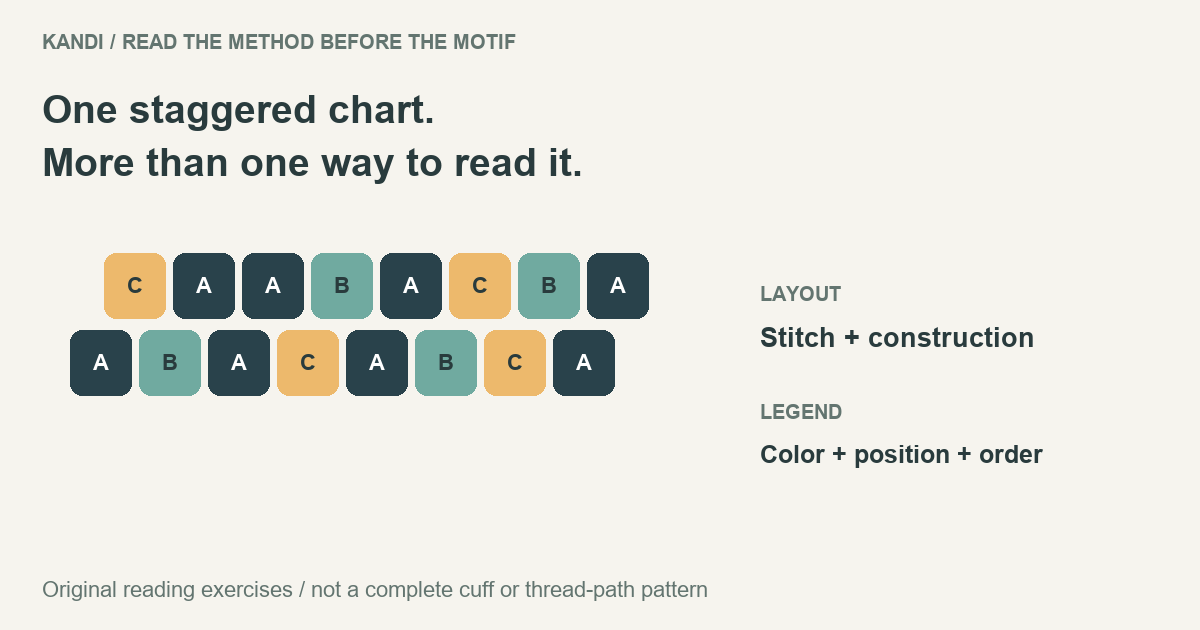
In this brick-layout excerpt, A is ink, B is lagoon and C is amber. Row labels sit on the left; position labels run across the bottom. Row 2, position 4 is therefore B. Neither the letter B nor the coordinate 4 says which bead to pick up fourth.
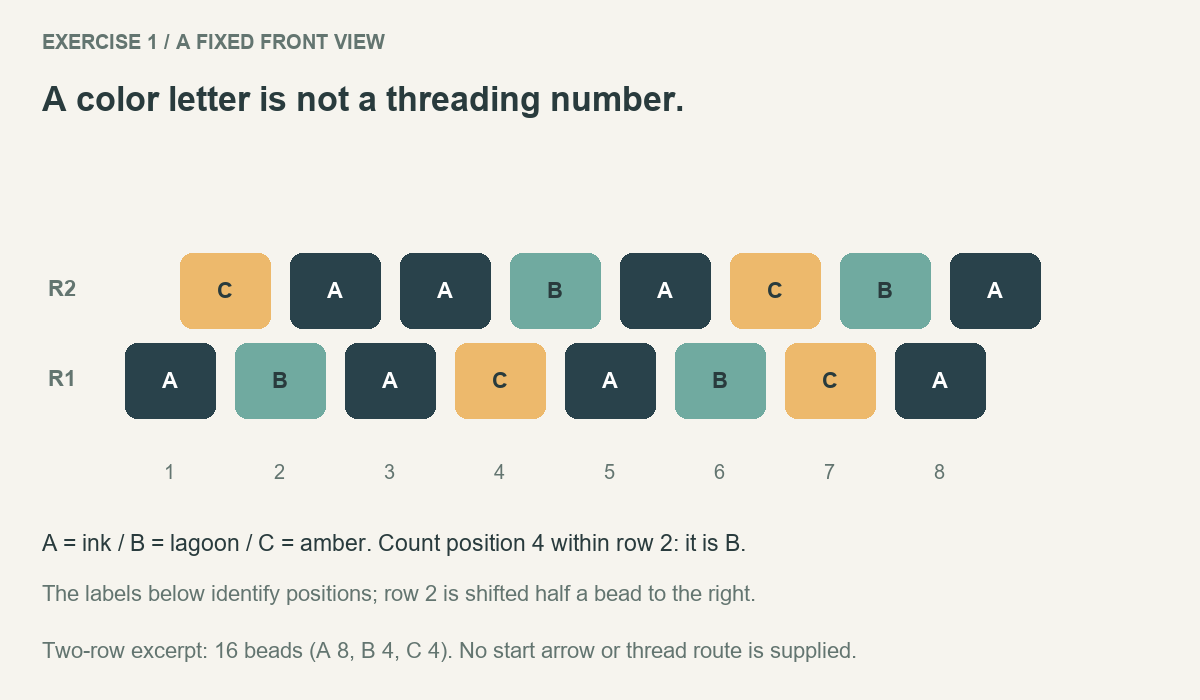
Original coordinate exercise. Read both strings left to right in the fixed front view; no working direction is prescribed.
The bottom row reads A B A C A B C A; the upper row reads C A A B A C B A. Each contains eight beads. The total is A: 8, B: 4 and C: 4. If your totals differ, check the row you counted before changing the colors. If totals match but the motif is reversed, check orientation instead.
Read the first two peyote rows as one pickup
For this separate even-count exercise, pick up the eight colors A B C A B A C B in that order and label those beads 1–8. The labels track individual beads; they are not palette numbers. Any temporary stop bead is outside this count.
Beadaholique's peyote chart-reading explanation distinguishes the first two rows in the initial pickup. In our example they contain four beads each. With the working thread exiting bead 8, the next four additions are C, A, B and C:
- Add bead 9 in C, skip bead 8 and pass through bead 7.
- Add bead 10 in A, skip bead 6 and pass through bead 5.
- Add bead 11 in B, skip bead 4 and pass through bead 3.
- Add bead 12 in C, skip bead 2 and pass through bead 1.
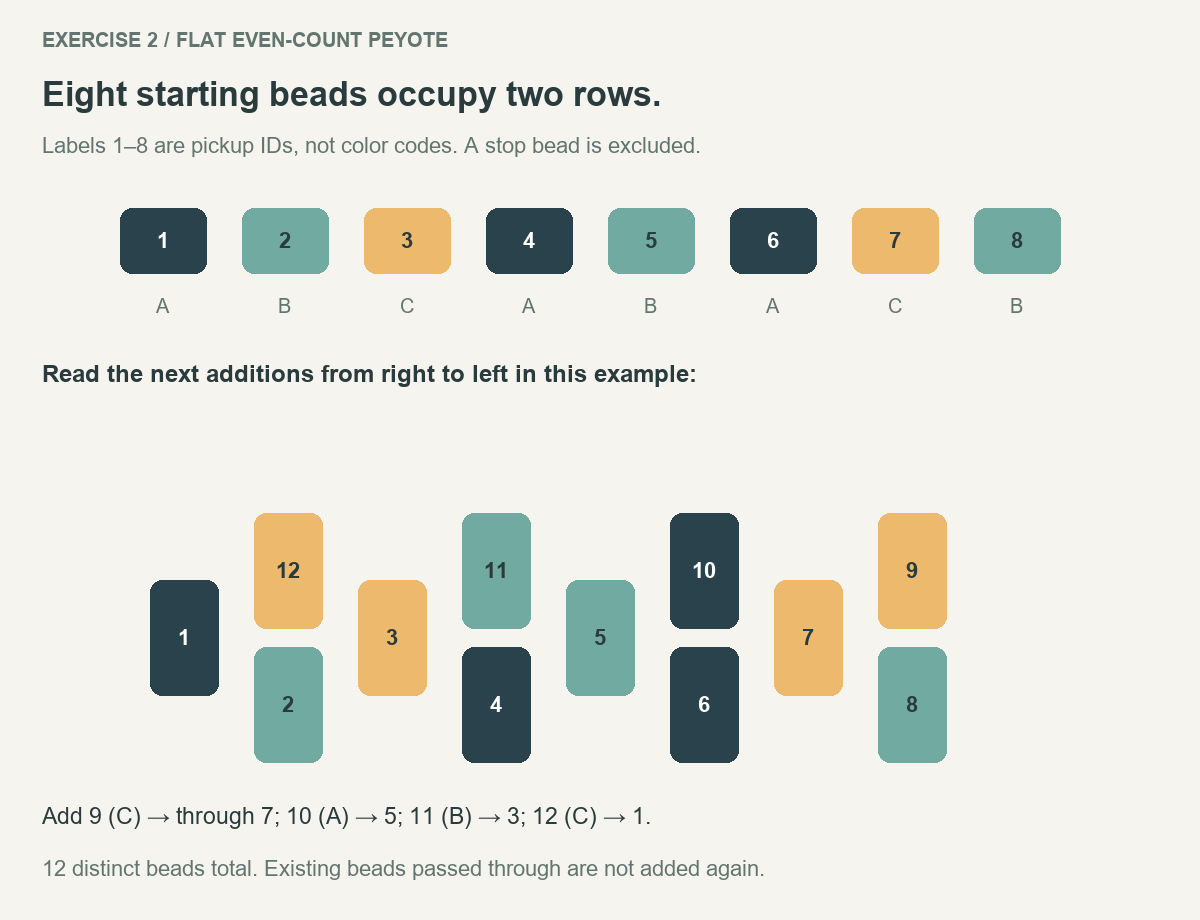
Reading/counting schematic: the eight existing beads are repositioned, not duplicated. No full thread route or edge turn is drawn.
You now have 12 beads, not 16: eight already present plus four new ones. Passing through an existing bead does not add it to the shopping count again. This exercise stops before the next turn; it is not a complete bracelet pattern.
Check where a cuff round begins again
When reading a kandi cuff chart, determine whether its ends are genuinely open or whether the drawing has flattened a closed circuit onto the page. Kandi Pad's reading lesson explicitly separates its flat-panel illustrations from cuff threading instructions. Row labels must be interpreted within that source's method.
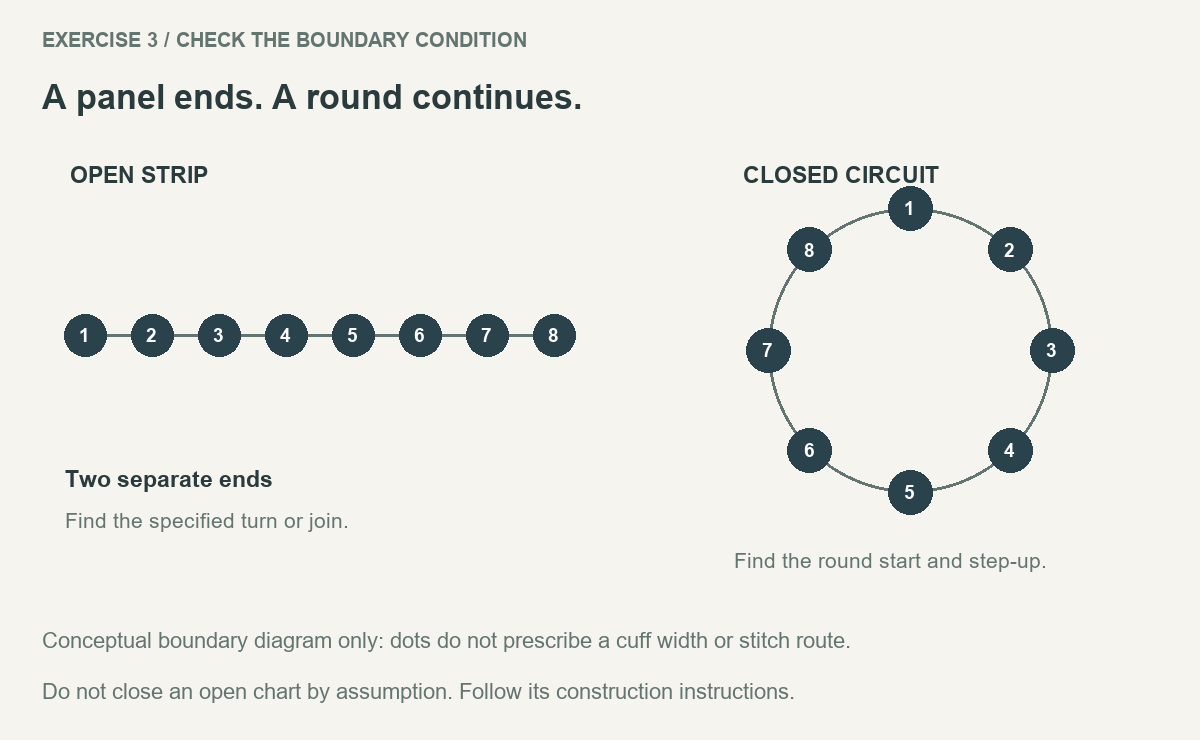
The same numbered positions can have different boundary conditions. This is a topology sketch, not an eight-bead cuff design.
In the even-count tubular peyote method shown by Beadaholique, the end of a round includes a step-up through the first bead added in that round. A flat-row turn is not a substitute. Do not apply that step-up indiscriminately to every pattern called a cuff.
Check What the Chart Does Not Tell You
Before threading a project, locate four items: its color legend, its starting sequence, its direction of work, and its edge or round transition. If one is absent, ask the designer or consult the matching technique lesson. A bead-count total cannot reconstruct missing instructions.
These examples supply no wrist measurement, tension allowance, closure recipe or complete thread path.
The flat brick-stitch pattern maker is appropriate when you need a color plan for that specific layout. It does not generate peyote cuffs or decide how their rounds connect. Save the exercise sequences and reading checklist to keep the distinctions beside your chosen pattern.