Beads / GUIDE
Small Perler Bead Patterns With Printable Grids
Six nature motifs, each under 80 beads. Compare their footprints, count out a shared color tray, and print the exact chart pages you need.
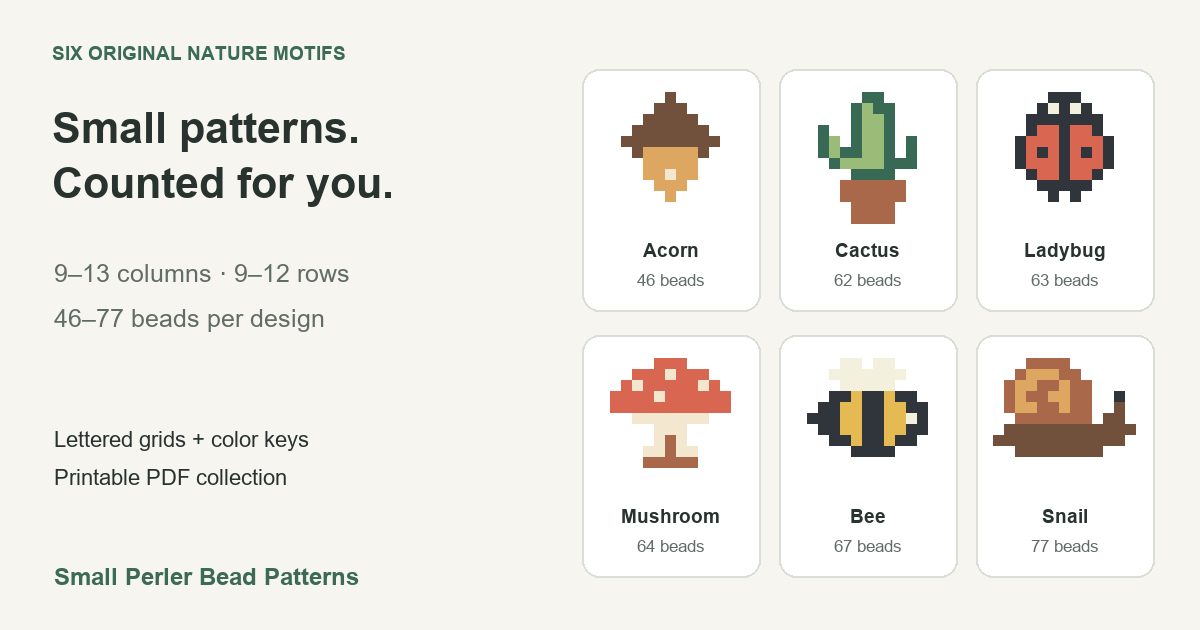
A small patch of empty pegs can be enough for a complete motif. These small Perler bead patterns use 9–13 columns, 9–12 rows and fewer than 80 beads apiece. The six drawings form a nature collection: an acorn, potted cactus, ladybug, spotted mushroom, striped bee and garden snail.
Choose by the space available on your square pegboard, then use the chart's letters to count out colors. The free PDF collection includes a shared supply list and a separate numbered grid for every motif.
Small Patterns by Grid Size
This collection uses a maximum of 16 × 16 grid positions as its definition of small; the actual drawings are smaller still. That is a size limit for these designs, not a required bead type. None of the motifs repeats the earlier easy Perler collection.
| Motif | Columns × rows | Beads | PDF page |
|---|---|---|---|
| Acorn | 9 × 10 | 46 | 2 |
| Potted cactus | 9 × 12 | 62 | 3 |
| Ladybug | 9 × 10 | 63 | 4 |
| Spotted mushroom | 11 × 10 | 64 | 5 |
| Striped bee | 11 × 9 | 67 | 6 |
| Garden snail | 13 × 9 | 77 | 7 |
A clear rectangular area of 13 columns by 12 rows accommodates any one of the six charts. They are not a combined layout: making several at once requires extra space. To use leftover room on a partly filled board, count the open columns and rows in that spot rather than the board's overall size.
Easy mini Perler bead patterns: what “mini” means here
Here, “mini” describes a compact picture. Perler Mini beads are a separate product size, with matching pegboards; Perler states that its Mini Beads pegboards are not for standard-size beads. These charts do not establish Mini-product compatibility or a finished measurement in inches. Select the board for the beads you actually have.
Acorn — 9 × 10
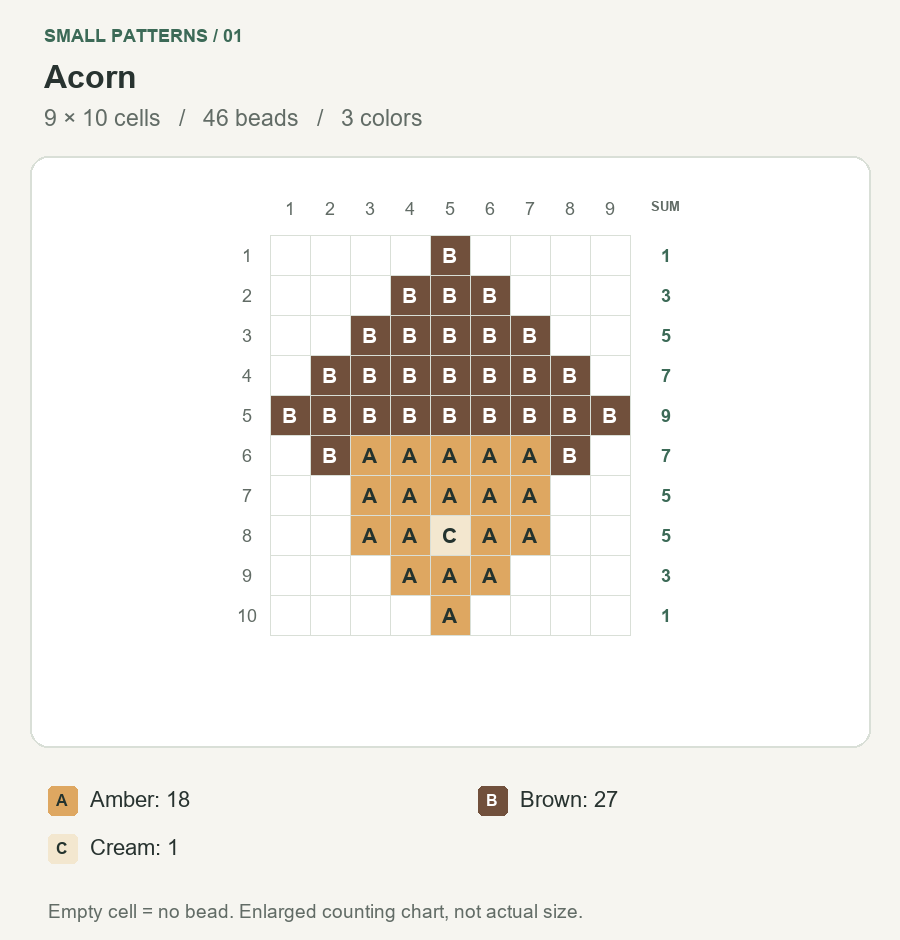
The cream bead sits at row 8, column 5. It is the only third-color accent; replacing it with amber gives a two-color acorn.
Potted cactus — 9 × 12
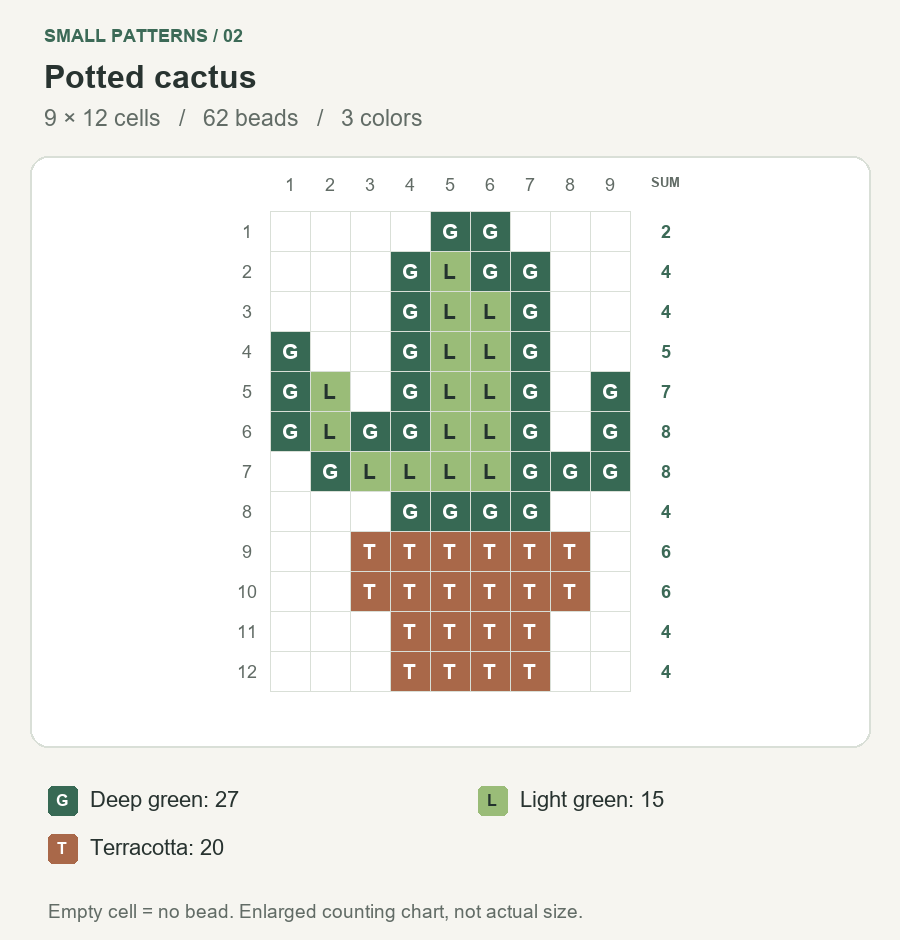
Leave column 3 empty in rows 4 and 5: it separates the left arm from the trunk. The arm joins the trunk across row 6.
Ladybug — 9 × 10
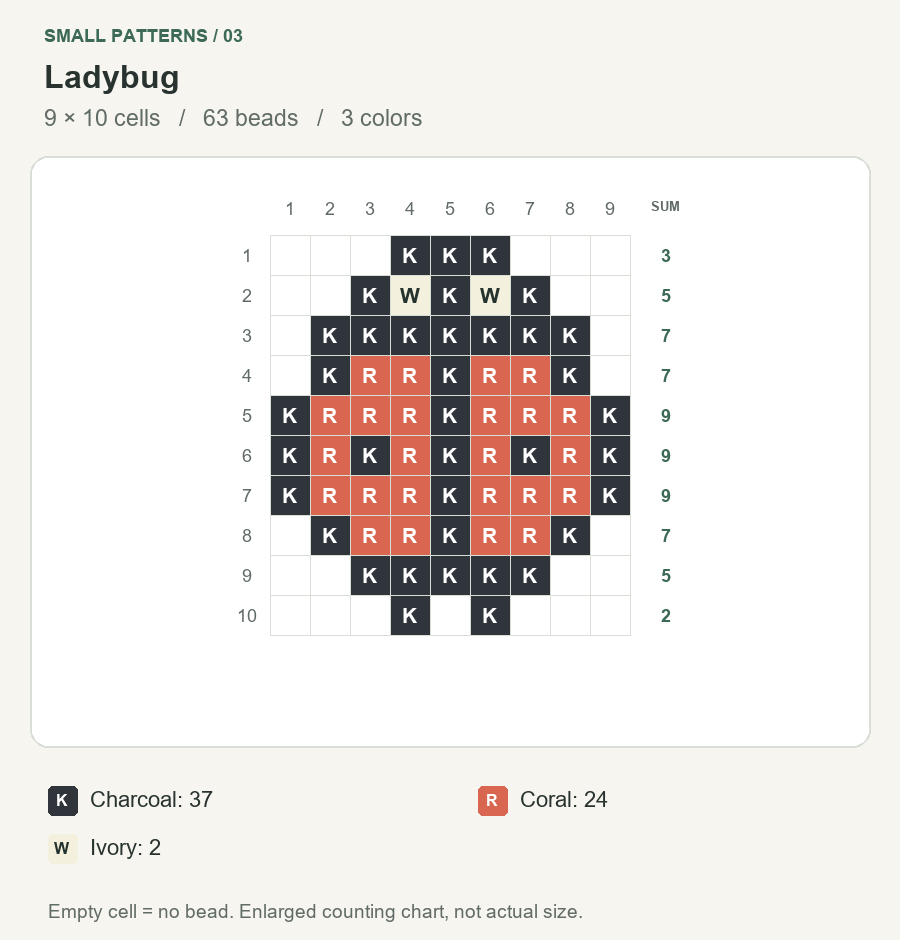
Column 5 is the dark center seam. Row 6 adds two side spots; the ivory pair in row 2 marks the eyes.
Spotted mushroom — 11 × 10
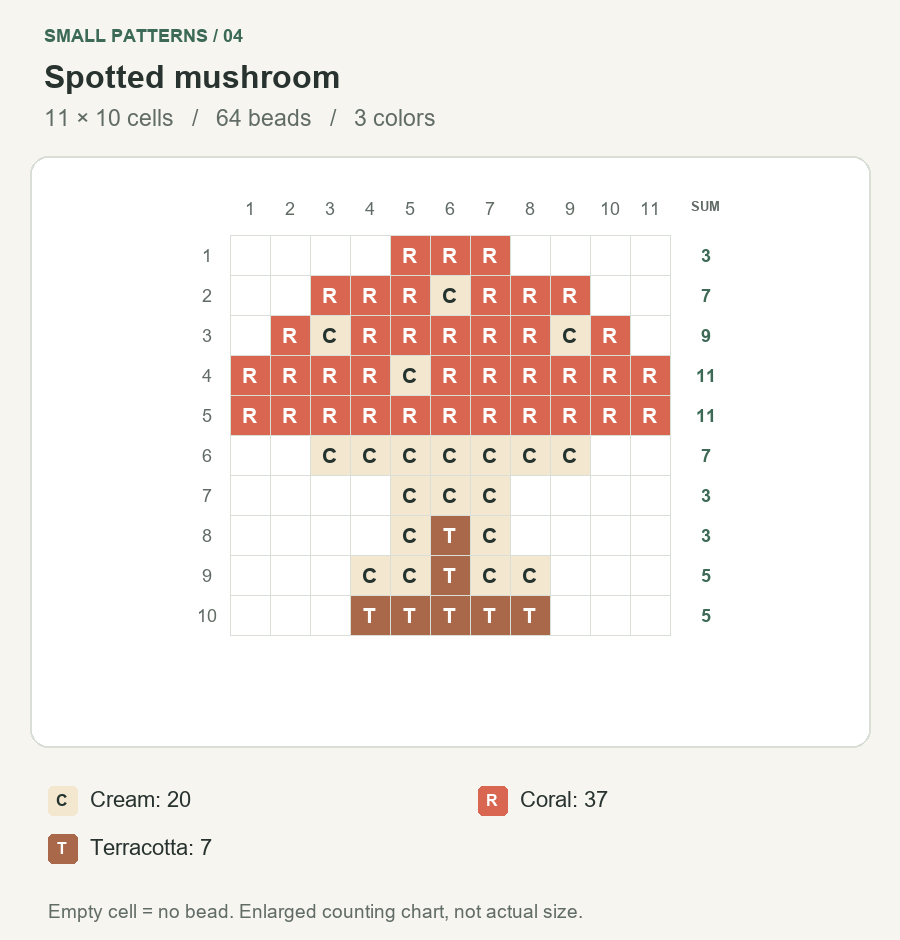
The coral cap is widest in rows 4 and 5. Its cream spots are occupied cells, while the empty corners around the cap stay unfilled.
Striped bee — 11 × 9
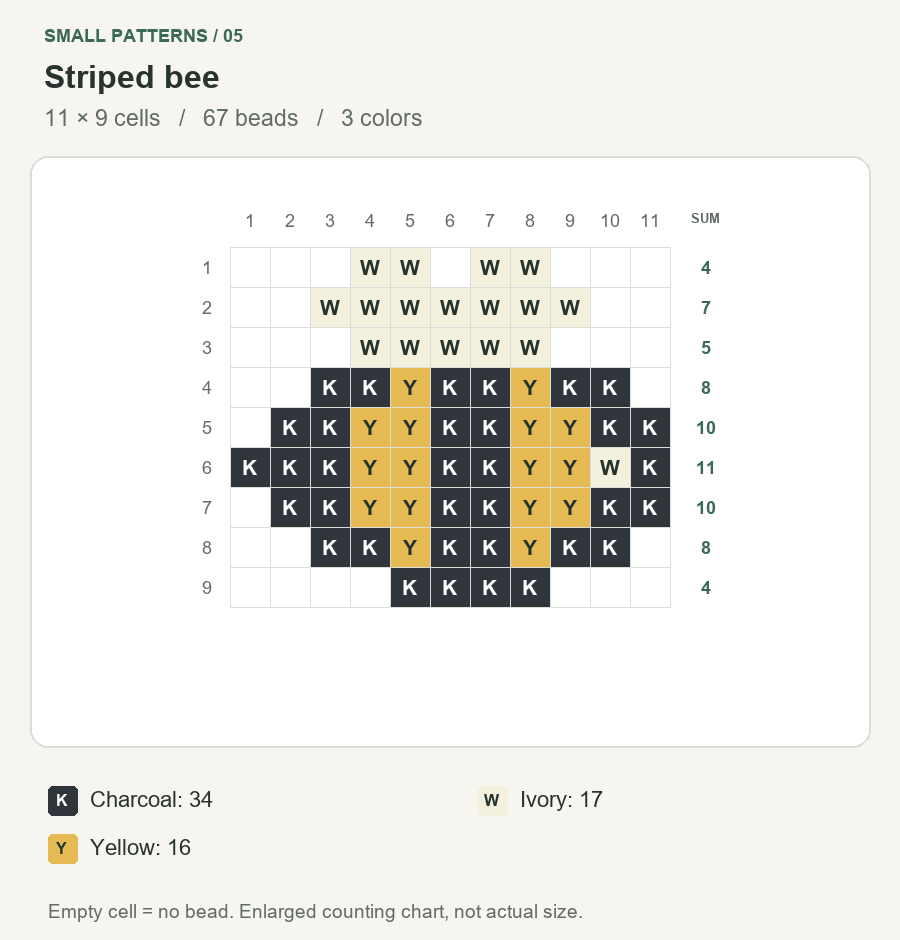
The two upright dark bands pass through the yellow body. Keep the pale wing cells, including the narrow top lobes, separate from the blank background.
Garden snail — 13 × 9
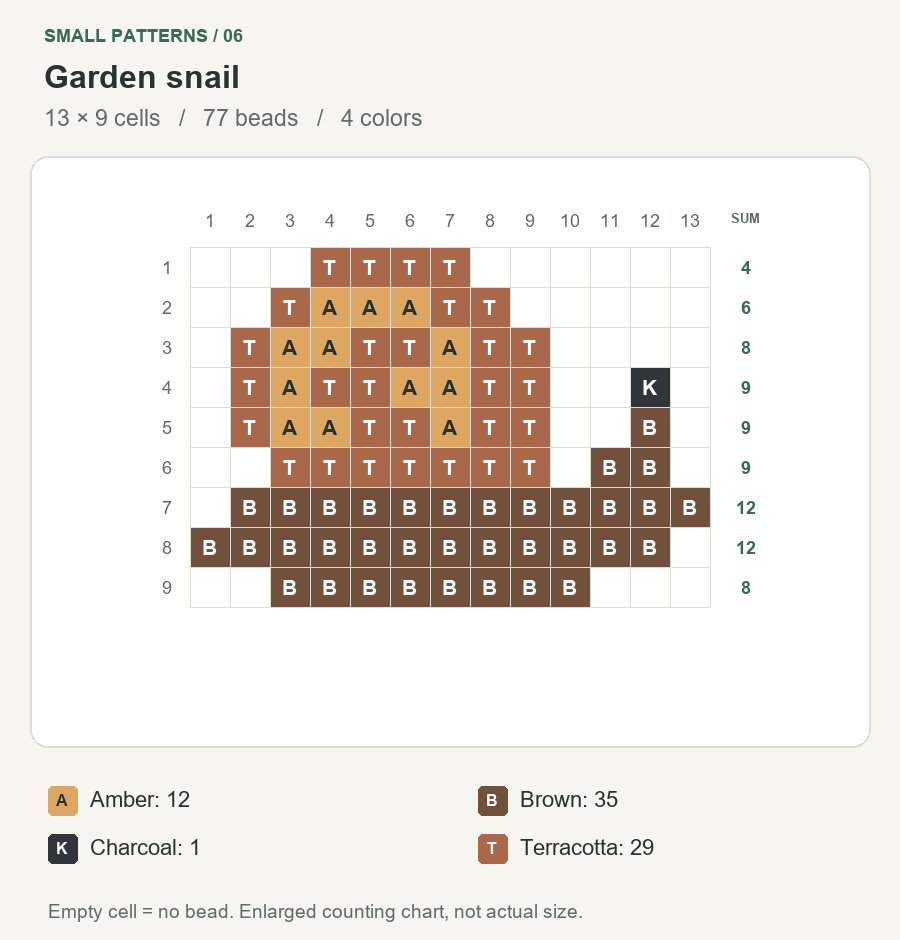
The single charcoal bead at row 4, column 12 is the eye. The brown cells below it connect the raised head to the long foot.
Bead Counts and Color Keys
Each occupied cell carries a letter, including the pale cream and ivory cells. Only unlettered cells represent empty pegs. Read the numbered rows from the top down; the SUM column on the right lets you check one completed row at a time.
The acorn illustrates why the footprint and supply count differ: its 9 × 10 rectangle has 90 positions, but only 46 contain beads. Those 46 comprise 27 brown, 18 amber and one cream. For the two-color version described above, put that cream bead back and take 19 amber instead; the total stays 46.
| Motif | Exact color quantities | Total |
|---|---|---|
| Acorn | A amber: 18; B brown: 27; C cream: 1 | 46 |
| Potted cactus | G deep green: 27; L light green: 15; T terracotta: 20 | 62 |
| Ladybug | K charcoal: 37; R coral: 24; W ivory: 2 | 63 |
| Spotted mushroom | C cream: 20; R coral: 37; T terracotta: 7 | 64 |
| Striped bee | K charcoal: 34; W ivory: 17; Y yellow: 16 | 67 |
| Garden snail | A amber: 12; B brown: 35; K charcoal: 1; T terracotta: 29 | 77 |
Prepare one tray for all six motifs
Making one of each original version takes 379 beads. Keep the cream and ivory groups separate if you want to reproduce the chart palette; they are close in appearance but have different letters.
- A — Amber: 30 beads.
- B — Brown: 62 beads.
- C — Cream: 21 beads.
- G — Deep green: 27 beads.
- K — Charcoal: 72 beads.
- L — Light green: 15 beads.
- R — Coral: 61 beads.
- T — Terracotta: 56 beads.
- W — Ivory: 19 beads.
- Y — Yellow: 16 beads.
These color names identify the drawings' swatches, not manufacturer shade numbers. A substitution is fine if the details remain distinct: for example, keep the snail's shell lighter than its brown foot. The supply totals above contain no allowance for dropped beads or test pieces.
The source grids were checked for counts and connections through shared cell edges. That confirms the digital layout, not the strength of a fused piece. In particular, the snail's raised head and the cactus arms have narrow joins. None of these designs has been physically fused for this article.
Print the Small Pattern Collection
Download the small pattern collection — seven-page PDF
Page 1 lists the motifs and the combined color tray. Pages 2–7 contain the individual charts in the order shown above, so you can enter a single page number in your print dialog instead of printing the entire set.
The PDF is laid out for US Letter. On A4, fit the page within the printable area. Its squares are deliberately enlarged for counting: changing the print scale will not make it a verified under-board template. Place the sheet beside your pegboard and follow the coordinates. In a grayscale print, use the cell letters and key rather than judging shades alone.
For the heating stage, use the instructions supplied with your bead product. Perler's standard fusing method assigns fusing to an adult. No iron temperature or timing has been tested with this collection.
A custom motif needs its own grid and count. The Perler bead pattern maker can create that starting chart from your image; check its footprint against the space you have before setting out the beads.