Crochet / GUIDE
How to Filet Crochet: Read a Chart and Make a Small Sample
Turn five chart blocks into shared posts, chain spaces and solid mesh. Work through the starting-chain calculation and a small stepped-opening layout.
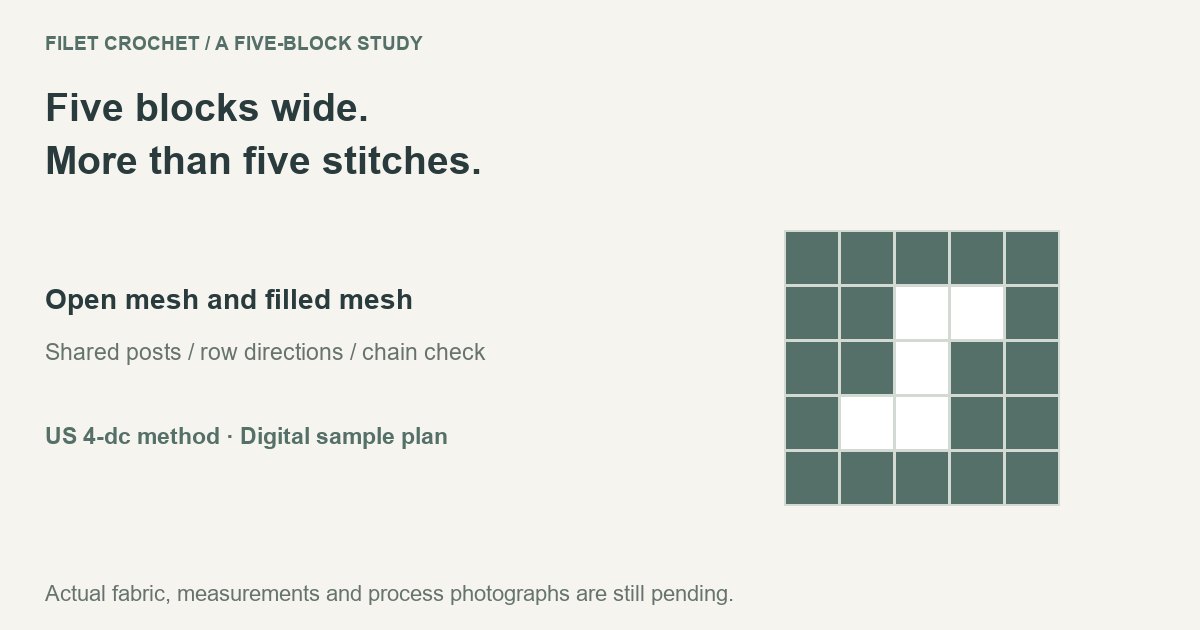
Five filled boxes do not mean five double crochets—or twenty. In the US 4-dc mesh used here, neighboring boxes share a boundary, so five filled boxes span sixteen dc positions. That shared stitch is the first thing to settle when learning how to filet crochet.
This lesson uses a new five-row stepped-opening layout to connect chart cells with actual stitch actions. Its counts and starting-chain method have been checked against references and arithmetic. The layout remains a digital sample plan: it has not yet been crocheted, photographed or measured.
Understand Open and Filled Mesh
Use one yarn throughout. The chart's dark and light cells describe dense and open areas, not two yarn colors. US double crochet is abbreviated dc, and chain is ch.
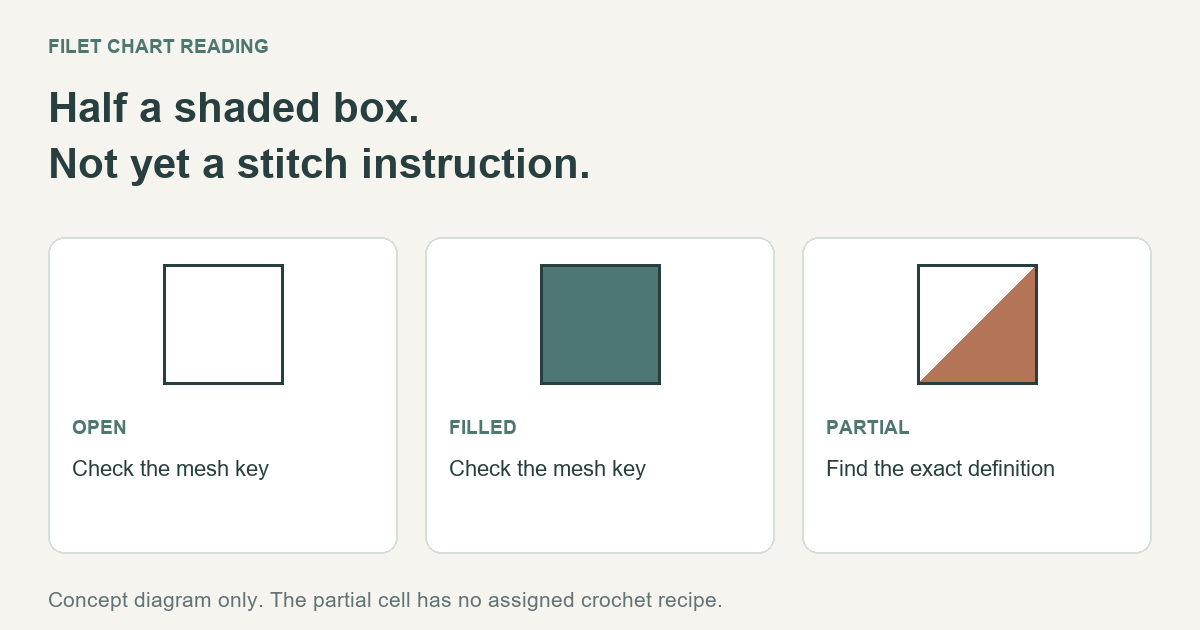
- Filled mesh: four dc positions from one boundary to the next. Once the starting boundary exists, add three dc to reach the following boundary.
- Open mesh: two boundary posts separated by a chain-two space. Once its first post exists, work ch 2 and a dc at the next boundary.
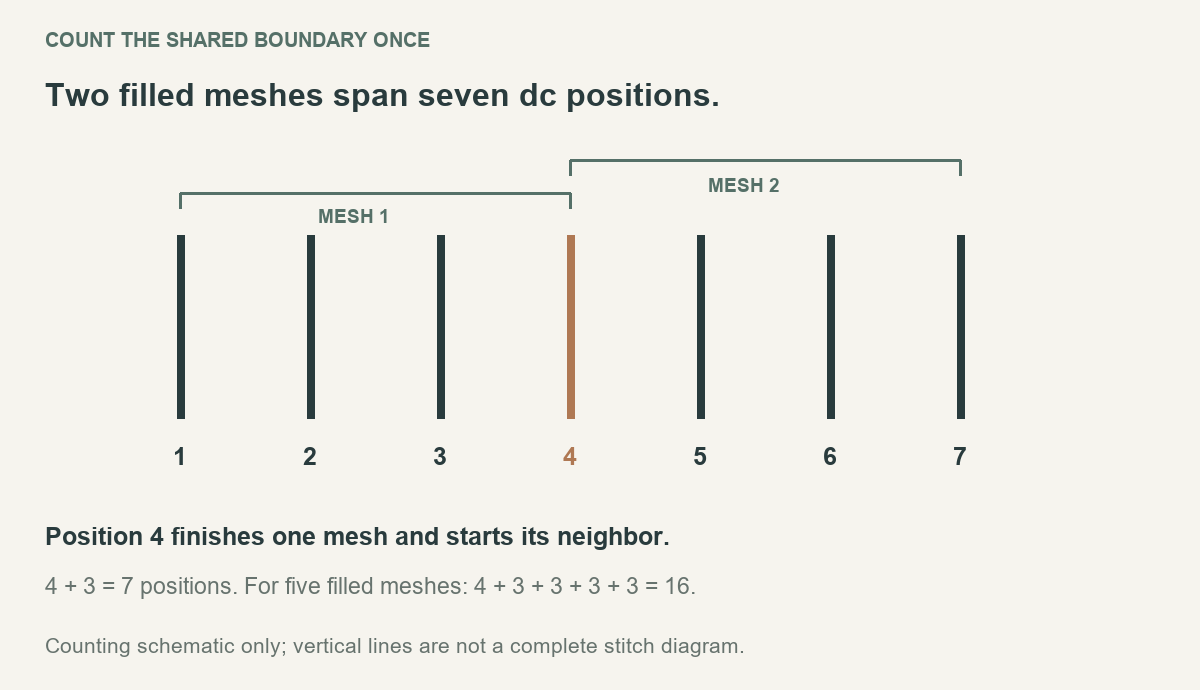
Count the orange boundary only once. Two adjacent solid meshes need seven dc positions, including their outer edges.
The teaching convention in Hooked on Häkelmaschen's 4-dc mesh lesson describes three positions per cell plus a closing stitch. Here we place the first boundary before reading the cells. Both account for the same shared structure; the crucial point is not to add four new stitches for every box.
How to do filet crochet over the previous row
After establishing the first boundary post, use these actions for each cell:
| New cell | Cell underneath | Action to the next boundary |
|---|---|---|
| F: filled | Filled | Dc in each of the next 3 stitches. |
| F: filled | Open | Work 2 dc into the ch-2 space, then dc in the next boundary post. |
| O: open | Filled | Ch 2, skip the next 2 stitches, dc in the next boundary post. |
| O: open | Open | Ch 2, pass over the existing ch-2 space, dc in the next boundary post. |
This sample places the two filling stitches into the space when closing an opening. Keep that choice consistent rather than switching unpredictably between the space and individual chain loops.
Read the Chart One Row at a Time
How to read a filet crochet chart for this sample
The key is F = filled and O = open. Read row 1 from the bottom-right corner, then alternate direction for the turned rows. All five rows begin and end with F, so every later row can use the same ch-3 start.
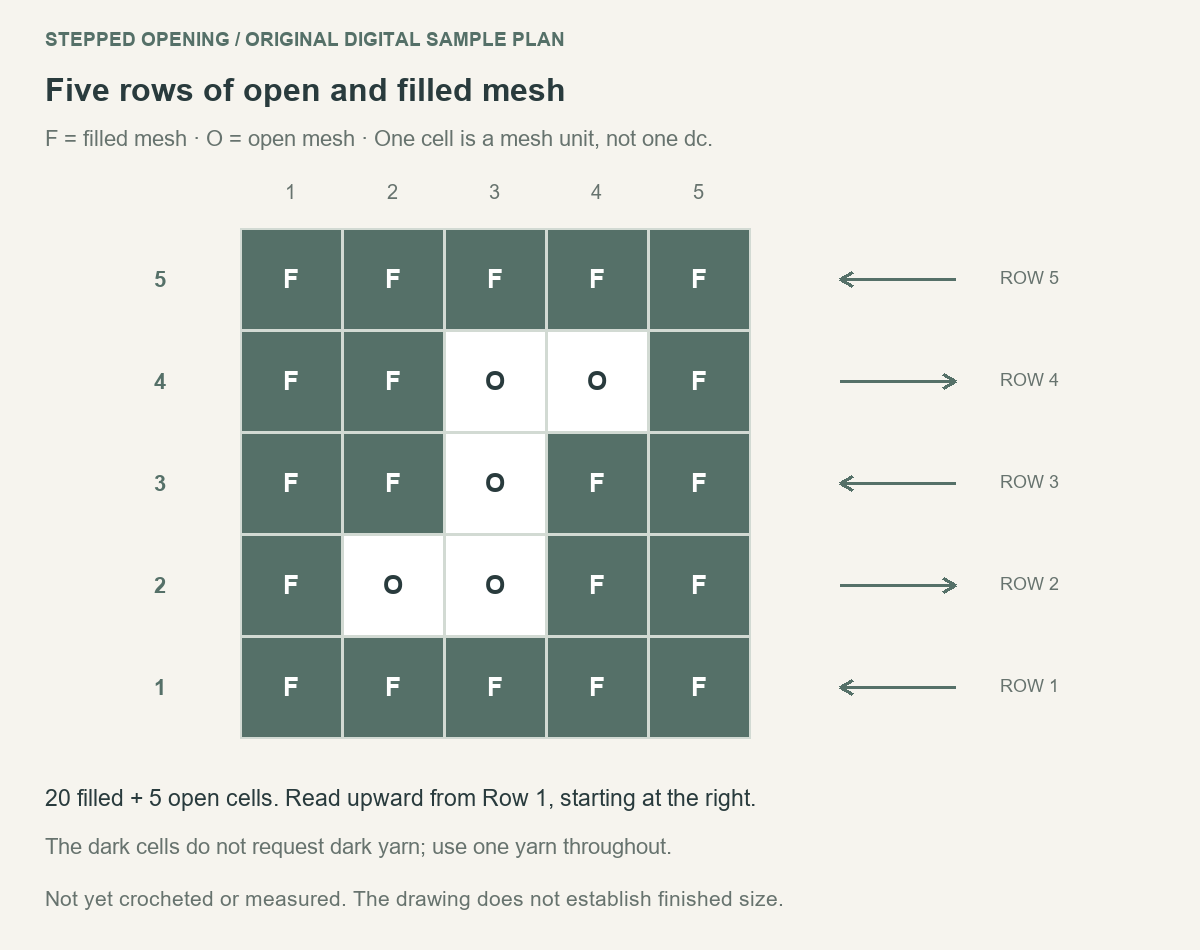
A stepped opening surrounded by filled mesh. Column numbers stay fixed while the direction of work alternates.
| Row | Cells in working order | Dc count* | Ch-2 spaces |
|---|---|---|---|
| 1 | F · F · F · F · F | 16 | 0 |
| 2 | F · O · O · F · F | 12 | 2 |
| 3 | F · F · O · F · F | 14 | 1 |
| 4 | F · F · O · O · F | 12 | 2 |
| 5 | F · F · F · F · F | 16 | 0 |
*The dc count includes the starting ch-3 as one dc. Chain spaces are listed separately. The sixteen-position width does not mean every row contains sixteen dc stitches.
When practicing how to read filet crochet charts, compare a new cell with the one directly below it. On row 3, column 2 becomes filled above an opening from row 2: that is where the two dc belong in the chain space. Column 3 stays open, giving you a different operation in the same row.
Make and Check a Small Filet Sample
Start with 18 chains, then verify the first row
Choose a smooth yarn or thread and a compatible hook for a trial. The chosen setup follows Dream a Little Bigger's filled-start method: 5 blocks × 3 + 3 = 18 chains. Work a dc into the fourth chain from the hook, then into every remaining chain.
Check it independently: chains 4 through 18 provide 15 worked dc; the three skipped chains stand for the first dc. Together they give 16 dc positions, matching 4 + 3 + 3 + 3 + 3 for the five filled meshes.
Keep the chain count and insertion point paired. The alternative setup in Hooked on Häkelmaschen's lesson adds an extra base chain and starts in the fifth chain; for five blocks that would be 19 chains. Do not combine its chain total with this sample's fourth-chain start.
Open the spaces, then fill them again
For row 2, turn and ch 3; this replaces the first dc, so do not work another dc into the stitch directly beneath it. Work 3 dc for the first F, then twice work ch 2, skip 2 stitches and dc in the next stitch. Finish with 6 dc for the final two filled cells. The row has 12 dc positions, including the turning chain, and two ch-2 spaces.
For rows 3–5, establish the same ch-3 boundary and apply the four actions above to the listed cells. The last boundary of each row goes into the top of the previous row's starting ch-3. On the final all-filled row, replace each remaining opening with two dc in its space and retain every boundary post.
Record what the fabric actually does
Five blocks across and five rows tall do not establish a square finished size. Crochet.com's filet guidance notes that stitch height can make the mesh look rectangular. Record the yarn, hook, width and height after making the sample; if you block it, note the method and measure again once dry.
Before fastening off, check that each row has five mesh units, that the openings occupy the charted positions, and that neither outer boundary has been dropped. A recorded measurement and a front/back photograph belong with those checks; no physical result is claimed for this digital plan.
Save the five-row workplan and measurement record. This filet crochet tutorial provides the chart calculations; use the record to note the dimensions and behavior of your own sample.
To develop another full-block motif after practicing, use the filet crochet pattern maker. It supplies the block chart; it does not calculate the starting chain or provide the complete crochet recipe used in this lesson.